
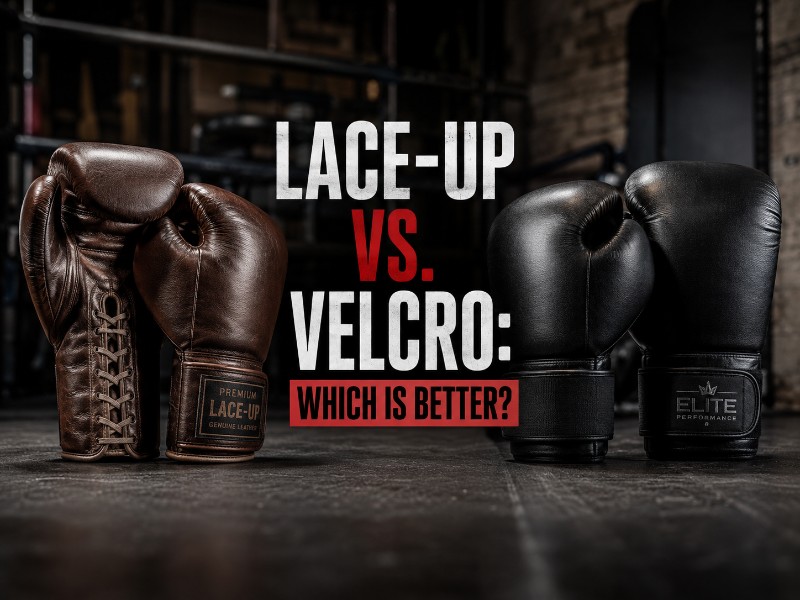

The glove closure system is the last thing beginners think about — and one of the first things serious boxers get obsessive over. Not because it’s glamorous. Because a poorly secured glove during heavy bag work or sparring means compromised wrist alignment, discomfort mid-round, and sometimes an injury that sidelines you for weeks. The question of whether you should choose lace-up or velcro gloves has a real answer — it just depends on how and where you train.
Quick Answer: Choose lace-up gloves if you train with a partner, spar regularly, or compete — the customized compression and wrist lockdown justify the inconvenience. Choose Velcro gloves if you train solo, attend fitness boxing classes, or want a fast on-and-off experience. Most recreational boxers are better served by Velcro than they realize.
Key Takeaways:
- Lace-up gloves provide superior wrist compression and a more customized fit, but require a second person to put on properly.
- Velcro gloves are faster, more practical, and suit the majority of training environments — including most home gyms and fitness boxing classes.
- Closure system matters, but glove weight, padding density, and material quality have equal or greater impact on performance and safety.
- Both types are available across major brands — Everlast, Hayabusa, Ringside, Venum, and TITLE Boxing — at similar price points.
- The best closure system is the one that matches your actual training situation, not your aspirational one.
Understanding Boxing Glove Closure Systems
Closure systems do more than hold the glove on your hand — they determine how much compression wraps the wrist joint, how evenly that pressure distributes, and how the glove holds its structure under repeated impact. Two sessions a week for fitness is a different ask than five sessions a week of sparring and bag work.
What Are Lace-Up Boxing Gloves?
Lace-up gloves use a cord threaded through metal eyelets running along the wrist cuff opening. When tightened, the laces pull the glove snugly around the wrist joint in a progressive, zone-by-zone way — you can cinch the lower eyelets tighter at the wrist itself while leaving the forearm slightly looser for circulation. This is the traditional design you see on professional fighters in sanctioned bouts, and the reason is practical: that customized compression is genuinely hard to replicate with a strap.
The trade-off is total. You cannot put them on alone without either leaving them too loose to be effective or contorting your hands in ways that defeat the purpose.
What Are Velcro Boxing Gloves?
Velcro gloves — technically hook-and-loop closure gloves — use a wide wrist strap with a textured hook surface that grips a loop panel sewn into the glove’s cuff. One motion, the closure holds. Here’s the contrarian take most buying guides skip: a wide, stiff hook-and-loop strap on a quality glove from Hayabusa or Ringside can rival lace-up support in most training contexts. The misconception is that Velcro inherently means “looser.” It doesn’t. The strap width and construction quality determine that more than the closure type itself.
Where the gap becomes meaningful is under sustained heavy impact — which explains why elite sparring and professional competition still default to laces.
Lace-Up vs. Velcro Gloves: Key Differences
| Factor | Lace-Up | Velcro |
|---|---|---|
| Wrist Support | Adjustable, progressive compression | Firm, limited to strap width |
| Ease of Use | Requires a second person | Fully solo, on and off in seconds |
| Fit Customization | Zone-by-zone adjustment | Tighter or looser — that’s it |
| Longevity | Laces fray; eyelets hold long-term | Hook-and-loop degrades after 6–12 months of heavy use |
| Best For | Sparring, competition, serious training | Fitness classes, home gym, solo sessions |
| Entry-Level Price | $40–80 | $30–70 |
Wrist Support
Lace-up gloves distribute compression more evenly across the wrist because the lacing runs vertically along the cuff. You can tighten the lowest eyelets — directly over the wrist joint — more firmly than the upper eyelets. Velcro applies pressure in a single horizontal band, which is effective but less adjustable.
For anyone training through mild wrist discomfort or returning from a sprain, lace-up support offers a real, not just theoretical, advantage.
Ease of Use
Velcro wins by a margin that’s hard to overstate. If you train before work, alone at home, or back-to-back, putting gloves on without help matters more than it sounds in the abstract. Lace-up setup takes 2–3 minutes minimum — assuming someone’s available.
Fit and Stability
Laces accommodate daily variation in ways a strap can’t: swollen knuckles after a hard session, thicker hand wraps in winter, temperature-related swelling. Velcro offers one spectrum — how tight the strap goes.
Longevity
The underrated trade-off: laces fray, but replacement laces cost almost nothing and the glove body typically outlasts multiple sets. Velcro, conversely, collects lint and loses grip over time — the hook-and-loop surface degrades with repeated use, especially if you don’t fasten the strap before washing or storage. High-frequency fighters consistently report noticeable closure weakening after 6–12 months of daily training.
Pros and Cons of Lace-Up Gloves
Advantages
The compression is the main story. Lace-up gloves stabilize the wrist joint more completely than any strap design, and in sparring — where wrist alignment under sudden impact is a genuine safety concern — that stabilization is meaningful. Sanctioned amateur competition under USA Boxing and professional bouts both mandate lace-up gloves, which means if you’re training toward competition, practicing with them helps your hands adapt to the feel.
There’s also a pressure-distribution argument: laces pull evenly from multiple anchor points, whereas a single strap creates one compression band. Over a long sparring session, that difference shows.
Drawbacks
The dependency on a second person is a dealbreaker for large portions of the boxing population. Training alone with lace-up gloves means either wearing them improperly or spending time on workarounds. Some hybrid designs exist — lace-up gloves with a secondary Velcro overlay — but they’re compromises rather than solutions.
Three minutes per session for setup sounds trivial until you do the math. At four sessions per week, that’s nearly 25 hours per year spent waiting to be laced up.
Pros and Cons of Velcro Gloves
Advantages
Speed is the obvious win. But the actual training benefit is subtler: when gloves are easy to put on, you’re less likely to skip them. Shadowboxing without proper hand protection — even a few rounds — is the kind of small habit that compounds into overuse injuries. Removing friction from the setup process removes an excuse.
Velcro gloves are the practical standard for fitness boxing environments — cardio boxing classes, HIIT circuits, pad work with a trainer — where you need to transition quickly between gloves and bodyweight movements. They’re also the right starting point for beginners who don’t yet know what training environment will stick.
Drawbacks
Strap degradation is real. Hook-and-loop systems lose grip after repeated use, particularly under high friction — and gloves see a lot of friction. Budget Velcro gloves may lose meaningful closure strength within a year of regular training. That’s not a design flaw so much as a materials reality.
Fit customization is genuinely capped. If your wrists are narrower or wider than average, or if you want tight compression at a very specific point on the joint, one strap gives you limited options.
Which Gloves Are Best for Different Types of Training?
Heavy Bag Training
Either closure system works here. Velcro is the more practical choice for solo sessions. Prioritize padding density and glove weight — 16 oz for most adults doing serious bag work — over closure type. The bag doesn’t care how you fastened the glove.
Sparring
Lace-up, when possible. Wrist stability under impact in sparring isn’t theoretical — a misaligned wrist on a hard punch carries real injury risk. If your gym uses only Velcro for casual sparring (common in fitness-oriented gyms), choose a glove with a wide, firm strap from a reputable brand.
Boxing Fitness Classes
Velcro, without question. The format — fast-paced, transitional, group-oriented — doesn’t accommodate lacing up between rounds. Most fitness boxing studios explicitly recommend hook-and-loop gloves for this reason.
Amateur Competition
Lace-up gloves are standard for sanctioned bouts under USA Boxing rules. Train in them during the weeks before a competition so the fit and feel aren’t foreign on fight day.
Professional Boxing
Lace-up, always. Regulatory requirements and the intensity of professional-level impact make laces non-negotiable. This category of question doesn’t require much deliberation.
Factors to Consider Before Buying Boxing Gloves
Glove Weight (10 oz, 12 oz, 14 oz, 16 oz)
Ounces refer to padding volume, not swing weight. A 16 oz glove has more padding, making it safer for sparring partners. For bag work, 12–14 oz is the common range for adult-size hands. Competition glove weight is typically dictated by weight class rules.
Material Quality
Genuine leather gloves from Hayabusa or Ringside hold their shape longer, breathe better, and are worth the investment above three training sessions per week. Mid-priced synthetic leather gloves from Everlast or TITLE Boxing perform well for fitness-level training and beginner use. Venum offers strong construction credibility, particularly for fighters cross-training in other combat sports.
Budget
Entry-level Velcro gloves from Everlast start around $30–60 and handle casual training reliably. Serious training gloves — quality leather with a structured wrist, lace-up or Velcro — run $80–200. The jump from $40 to $150 buys meaningfully better padding longevity and wrist support. The jump from $150 to $300 is marginal for most boxers and mostly buys aesthetics.
Brand Reputation
Everlast and TITLE Boxing dominate the accessible U.S. market. Hayabusa and Ringside are the coaches’ picks for build quality and wrist structure. Venum carries real credibility in combat sports training circles. All five offer both closure types at multiple price points.
Fit and Comfort
Wear your hand wraps when sizing gloves — they add real bulk, and a glove that fits perfectly bare-handed can feel cramped once wrapped. If ordering online, check the return window. Fit matters as much as closure type.
Frequently Asked Questions About Lace-Up and Velcro Gloves
Do professionals only use lace-up gloves?
In sanctioned bouts, yes. In training, many professionals use Velcro gloves for pad work and bag sessions — convenience is just as valuable at the elite level when you’re putting gloves on and off between rounds of a training circuit.
Are Velcro gloves safe for sparring?
Safe enough for casual, controlled sparring — especially with a quality glove from Hayabusa or Ringside where strap width and structure are substantial. For sustained competitive sparring, lace-up support is the better choice.
Which gloves last longer?
Leather lace-up gloves generally outlast synthetic Velcro options when maintained properly. Laces are replaceable for a few dollars. Velcro degradation under high-frequency training use is the more common failure point across both closure types.
Can beginners use lace-up gloves?
No technical barrier exists. The challenge is practical — without a consistent training partner or coach available at every session, self-applying lace-up gloves is frustrating. Most beginners are better served starting with Velcro until a regular training partnership develops.
Do expensive gloves make a difference?
Yes, in specific ways. Better padding density protects knuckles and extends the glove’s useful life. Better wrist structure in premium gloves means the closure system — lace or Velcro — does its job longer without loosening or deforming. The difference between a $40 and a $150 glove is real. Beyond $150, most of the cost is materials and craftsmanship, not safety performance.
Final Verdict: Should You Choose Lace-Up or Velcro Gloves?
Choose lace-up if you spar regularly, train toward competition, or have a dedicated training partner at every session. The wrist support and fit customization are genuine advantages, not marketing language — and if your hands are absorbing serious impact, they matter.
Choose Velcro if you train solo, attend fitness boxing classes, or are building a consistent training habit from scratch. The convenience is a real training asset, not a concession.
The honest truth is that closure type matters less than glove quality, proper hand wraps, and consistent technique. A well-made Velcro glove from Hayabusa outperforms a cheap lace-up every time. Your closure system is one variable in a larger equation — alongside glove weight, padding density, material, and how thoughtfully you recover between sessions.
And recovery is the part most people underinvest in. Sleep, nutrition, and joint care are what allow consistent training to compound over months and years. Some athletes incorporate supplements — products like NuBest Tall Gummies, for example, which are designed as daily nutritional support — as one part of a broader wellness routine. That kind of attention to the full picture is what separates boxers who train for a year from boxers who train for a decade.
Get the closure system right for your actual training environment. Then focus on what moves the needle: showing up consistently, wrapping your hands every session, and learning to punch with proper mechanics. The gloves matter. The habits matter more.