
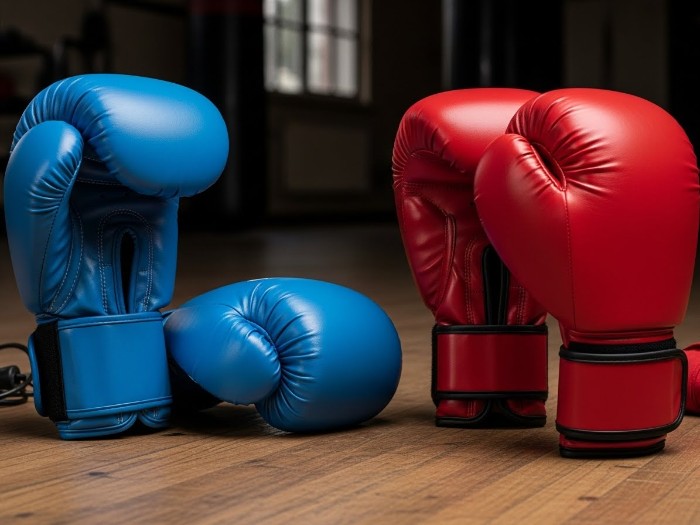

Most beginners assume boxing gloves are boxing gloves. One pair, all purposes. It’s an easy mistake — they look similar, they’re priced similarly, and nobody at the checkout counter is going to stop you. But using the wrong glove for the wrong job costs you equipment, costs your training partner some bruises, and — if you spar regularly with bag gloves — costs you gym membership when a coach notices.
The difference between sparring and bag gloves isn’t cosmetic. It’s structural, and it matters.
Key Takeaways
- Sparring gloves use softer, more evenly distributed padding to protect both you and your training partner.
- Bag gloves are built for repeated impact against heavy bags and focus mitts — denser foam, better feedback, faster wear if used wrong.
- Using bag gloves to spar puts your partner at genuine risk. Most gyms won’t allow it.
- Owning both types is the standard recommendation in American boxing gyms — not a upsell.
- Beginners typically do well with 14 oz or 16 oz sparring gloves and a dedicated pair of bag gloves for pad work.
- Proper care — airing out after training, keeping them dry — extends glove lifespan noticeably.
What Are Sparring Gloves?
Sparring gloves are built around one priority: protecting both people in the exchange. When you’re working with a partner, the padding has to absorb and distribute force instead of concentrating it. That’s what separates them from every other glove type.
The foam inside sparring gloves tends to be softer and layered across a larger surface area. The striking face is wider, which spreads force across the target rather than focusing it at a point. This is deliberate. You’re not trying to maximize damage — you’re training, and so is the person across from you.
Common weights run from 14 oz up to 18 oz. The heavier the glove, the more padding between your knuckles and your partner’s face. Most American gyms that follow USA Boxing guidelines require 16 oz minimum for sparring, especially for beginners. Closure options are typically hook-and-loop for solo training and lace-up for competition, though most gym sparring uses hook-and-loop for convenience.
Wrist support is another factor that gets overlooked until someone rolls an angle wrong. Quality sparring gloves have reinforced wrist bands — not decorative stitching, actual structural support.
What Are Bag Gloves?
Bag gloves are optimized for hitting things that don’t hit back. Heavy bags, focus mitts, Thai pads. The priority shifts from protecting a partner to protecting your hands across high-repetition impact.
The foam in bag gloves is denser. That density gives you feedback — you feel the impact, which helps with technique — and it’s more resistant to compression fatigue over time. A bag glove that loses its structure after 50 sessions is a bad bag glove.
They’re also generally lighter. A 10 oz or 12 oz bag glove keeps your hands moving faster than a 16 oz sparring glove, which is useful when you’re drilling combinations at speed. The trade-off is obvious: that lighter, denser padding is not what you want connecting with someone’s nose.
Most bag gloves are made from synthetic leather at entry price points, genuine leather at mid-range and above. Leather holds up significantly better over time. It’s not just about feel — it’s about whether the seams survive a year of bag work.
Sparring vs Bag Gloves: Key Differences
| Feature | Sparring Gloves | Bag Gloves |
|---|---|---|
| Foam density | Softer, layered | Denser, impact-focused |
| Striking surface | Larger, wider | More compact |
| Primary use | Partner drills | Heavy bag, focus mitts |
| Typical weight range | 14–18 oz | 8–14 oz |
| Lifespan on bag work | Shorter (foam compresses faster) | Longer |
| Lifespan in sparring | Longer | Not suitable |
| Feedback on impact | Reduced (by design) | High |
Padding Design
The foam construction is where everything else flows from. Sparring gloves use multi-layer foam — often a softer outer layer over a firmer inner core — designed to spread force laterally across a larger surface. Bag gloves skip that outer layer in favor of consistent density throughout. Less spreading, more absorption directly at the knuckle.
For sparring, you want force distribution. For bag work, you want shock absorption. These are not the same thing, and manufacturers design accordingly.
Intended Purpose
Sparring gloves are for live partner work: controlled exchanges, defensive drills, combination practice with a real human who would prefer not to leave training with a headache. Bag gloves are for solo or pad work — heavy bag rounds, focus mitt sessions, shadow boxing with weighted resistance.
Using each outside its intended context isn’t catastrophic on a one-off basis, but it catches up with you.
Durability
Here’s where the “just use one glove” logic falls apart. Sparring gloves aren’t built for the friction and surface texture of a heavy bag. The leather cracks faster, the seams stress differently, and the softer foam compresses under bag work in ways that don’t recover. Bag gloves used for sparring don’t degrade as dramatically — they just become a risk to whoever’s in front of you.
Comfort and Feel
Bag gloves give you more feedback on each punch. You feel contact clearly, which reinforces technique. Sparring gloves muffle that feedback slightly — intentional again. You’re reading your partner’s reactions and movement, not sensation in your hands.
Hand fatigue is also different. A heavier sparring glove tires your arms across long rounds. Bag gloves let you move faster, which can be its own kind of fatigue at high volume.
Can You Use Sparring Gloves on a Heavy Bag?
Short answer: occasionally, yes. As a regular habit, no.
Sparring gloves will survive bag rounds. The foam holds up fine for a session or two when you’re in a pinch — forgot your bag gloves, traveled without them, whatever. The problem is cumulative. The softer foam in sparring gloves compresses under repeated bag impact and doesn’t rebound the way denser bag glove foam does. Over months, they lose their structural integrity faster than they would if used only for sparring.
There’s also a hygiene angle nobody talks about: heavy bags are not clean surfaces. Canvas and vinyl bags accumulate sweat, bacteria, and surface wear that accelerates leather cracking. Your sparring gloves will look and smell worse faster.
If your gym situation forces you to use one glove for everything, use a mid-weight bag glove — 12 oz or 14 oz — with quality construction. It’s a better compromise than running sparring gloves into a bag.
Can You Spar with Bag Gloves?
No. Not casually, not occasionally, not “just for light sparring.”
Safety Risks
The denser foam in bag gloves concentrates force instead of distributing it. In sparring, that means harder impact to your partner’s head and face on every exchange. The risk of cuts, nose injuries, and cumulative head trauma goes up. Even at controlled intensity, bag glove padding isn’t doing what a training partner deserves.
Gym Rules
Most gyms in the United States won’t let you spar with bag gloves, full stop. USA Boxing guidelines specify appropriate glove weight and construction for sanctioned sparring, and many gym policies follow or exceed those standards. A coach who sees bag gloves on someone about to spar is going to pull them out of the rotation. It’s not a preference thing.
Injury Prevention
This one is worth stating plainly: if your gym allows it, that doesn’t mean it’s safe. The number of sparring injuries that happen with appropriate equipment is already non-zero. Adding bag gloves to that equation isn’t a calculated risk — it’s just unnecessary risk.
How to Choose the Right Boxing Gloves
Choose by Training Type
If you’re sparring: 14 oz minimum, 16 oz if you’re new or if your gym requires it. If you’re primarily doing bag work: 10–12 oz for lighter combos, 12–14 oz for heavier bag rounds or pad work. If you’re doing both — which most people are — budget for two pairs.
Choose by Glove Weight
| Weight | Best For |
|---|---|
| 8–10 oz | Competition, very light pad work |
| 12 oz | Bag work, mitt drills |
| 14 oz | Bag and light sparring |
| 16 oz | Sparring (most common gym requirement) |
| 18 oz | Heavier sparring, extra protection |
Body weight is a rough guide too: fighters under 150 lbs often train at 14 oz, those over 185 lbs tend to spar at 18 oz for adequate protection on both sides.
Choose by Material
Genuine leather holds up better over time and molds to your hand more naturally. It’s worth the price jump if you’re training more than twice a week. Synthetic leather is fine for beginners or lower-frequency training — the gap between synthetic and leather matters more over a year of sessions than in the first three months.
Choose by Budget
Entry-level ($30–60): brands like Everlast’s core line and TITLE Boxing’s base tier cover this range. Adequate for beginners, expect to replace in 12–18 months with regular use.
Mid-range ($80–150): Hayabusa, Ringside, Venum. Noticeably better construction, longer lifespan, better wrist support.
Premium ($150+): Cleto Reyes, Winning. Handmade leather construction. What serious fighters use, and the price reflects it. Worth it if you’re training 4–5 times a week and you’ll keep them for years.
Best Boxing Glove Brands in the United States
Everlast is everywhere — Dick’s Sporting Goods, Amazon, most big-box sporting goods stores. The entry-level gloves are fine for casual training. The Pro line is worth the upgrade if you can find it.
TITLE Boxing has strong representation in gyms and is a solid mid-range choice. Good selection across weight classes and training types.
Ringside is a reliable gym staple. They’ve been around long enough that many American boxing coaches default to recommending them to beginners.
Hayabusa sits at the upper end of mid-range. Their wrist support is notably better than competitors at similar price points. Worth considering if wrist stability is a priority.
Cleto Reyes and Winning are the gold standard at the premium level — Mexican and Japanese craftsmanship respectively. Both brands have devoted followings among professional and serious amateur fighters. The price is real, and so is the quality difference.
Venum and Fairtex round out the mid-to-premium range and are widely available through Academy Sports + Outdoors and online. Fairtex has particular strength in Muay Thai-style gloves if that’s your context.
Common Mistakes When Buying Boxing Gloves
Buying one pair for everything. Already covered why this is a problem — but it’s the most common error, and manufacturers quietly benefit from it by not explaining glove categories at point of sale.
Choosing the wrong weight. Most beginners undersize. A 10 oz glove looks sleek, but if you’re sparring in it, you’re endangering your partner. Go heavier than you think you need for sparring; the extra weight on your arms is a feature, not a bug — it builds endurance.
Skipping hand wraps. This applies especially to bag gloves, where wrist torque on impact is real. Hand wraps protect the small bones in your hand and stabilize the wrist before the glove does. They’re not optional if you’re training regularly.
Buying based on price alone. The cheapest gloves break down fastest, often in ways that compromise protection before they look visibly worn. The foam compresses, the stitching separates, the velcro gives out. A $40 pair that lasts six months costs more per month than an $80 pair that lasts two years.
Not checking fit. A glove that fits wrong creates pressure points across knuckles or thumb positioning that adds up over rounds. If you can, try them on before buying. Your hand should sit naturally, fingers slightly curled, with no pinching.
Frequently Asked Questions
Do beginners need both sparring and bag gloves?
Technically you can start with one pair and specialize later, but you’ll save money long-term by getting purpose-built gloves from the start. A sparring glove used for bag work wears out faster than a bag glove would — you end up replacing both sooner.
Are 16 oz gloves good for beginners?
Yes. For sparring, 16 oz is the standard recommendation for most beginners at most weight classes. They’re heavier, which your arms will notice, but the extra padding is what makes sparring safer for both people. Most gyms in the U.S. require 16 oz for new members before adjusting based on body weight and experience.
How long do boxing gloves last?
With proper care — airing out after every session, keeping them dry, not storing them in a closed bag — mid-range gloves typically last 1–2 years with moderate training frequency (2–3 sessions per week). Premium leather gloves can last 3–5 years under the same conditions. Using gloves outside their intended purpose shortens that lifespan significantly.
Should you wear hand wraps with bag gloves?
Yes. Hand wraps protect structures the glove doesn’t — the small bones and joints in your hand and wrist. They also manage sweat inside the glove, which keeps the foam from breaking down as quickly. Make them a habit from the start.
Are expensive boxing gloves worth it?
For serious training — 4+ sessions per week — yes. The construction difference between premium and budget gloves is real: better leather, better foam that maintains its density longer, better stitching. If you’re training that frequently, the cost-per-session math often favors the premium pair. For casual training once or twice a week, mid-range is more than sufficient.
Worth Knowing Before You Buy
The glove category matters. But within that category, the single biggest variable in longevity is care after training — not brand, not price. Let them air out after every session. Don’t leave them in a closed bag. A cedar insert or specialized deodorizer helps. It’s not glamorous, but gloves that smell like a gym locker after three months are gloves you’ll replace sooner than you should