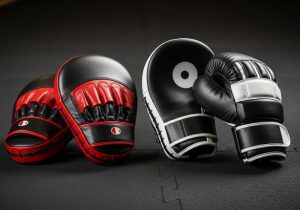


At first glance, boxing gloves and MMA gloves might seem like cousins — similar shape, same general idea. But once you’ve actually trained in both, you realize they’re built for completely different realities.
If you’ve ever slipped on a pair mid-session and felt the shift in how your hands move, you already know. The glove isn’t just equipment. It shapes your footwork, your timing, even your mindset going into contact.
Boxing gloves wrap your entire hand in dense padding — knuckles, wrist, the works — and they typically run between 10 to 16 oz depending on your weight and whether you’re training or competing. MMA gloves sit somewhere around 4 to 6 oz, with your fingers exposed so you can grab, clinch, and transition on the ground. That’s not a subtle difference. It’s the difference between throwing a jab and securing a wrist lock.
Here’s what most people skip over though: glove design doesn’t just change what you can do — it changes how you think. More padding in boxing means you can throw in volume without worrying as much about your knuckle bones. MMA gloves give you less room for error. A lazy, wide punch with thin padding and you’re eating that mistake in your hand for a week.
So it’s not really a “which is better” question. It’s about what you’re actually doing in the gym.
Glove Structure Comparison: Boxing vs. MMA Glove Build
Most people focus on weight when comparing gloves. That’s fine, but the build — how it’s layered, what’s protected, what’s left open — tells you a lot more about why each glove exists.
Boxing gloves are built around protection. MMA gloves are built around function. Once you sit with that, the rest starts making sense.
Materials, Padding & Enclosure: What Really Matters
A boxing glove is basically a padded shell. We’re talking dense foam up to three inches thick wrapping the full hand — thumb included, fully attached. That rounded, bulb-like shape isn’t accidental. It keeps your wrist in alignment and your knuckles cushioned whether you’re working mitts or going live. Most quality pairs use cowhide leather with reinforced stitching around the spots that take the most abuse.
MMA gloves operate differently from the ground up. The open-finger design lets you shoot underhooks, grab wrists, or flow into a submission without adjusting your grip every time. You’re getting maybe half an inch of padding, mostly over the knuckles. And the wrist strap is shorter — which means your forearm stabilizers are doing real work to keep things together.
Here’s where those structural choices actually show up:
- Padding layout
- Boxing: Full foam coverage across hand and wrist
- MMA: Thin knuckle padding, open palm and fingers
- Thumb setup
- Boxing: Thumb fully attached and padded — no surprises mid-combo
- MMA: Thumb semi-free or lightly attached — better for grappling, but riskier when striking
- Glove shape and weight
- Boxing: Rounded, bulkier profile, 10–16 oz standard
- MMA: Flatter build, 4–6 oz, better suited for clinch work
Something most beginners overlook: the thumb design alone can determine how long a glove holds up — and whether your ligaments do too. I’ve watched guys blow through two pairs in a month because the stitching around the thumb gave out too early. That’s not just inconvenient. That’s an injury waiting to happen. Even if you’re early in your training, foam density and solid thumb construction aren’t things to cut corners on.
A 2024 industry survey from FightGear Collective found that 72% of boxing coaches recommend at least 14 oz gloves for newer boxers — primarily to protect the wrist and keep knuckle bruising down. In MMA, the tradeoff leans the other way. You’re accepting slightly less protection in exchange for the range of motion you need on the mat.
Protection and Injury Risk: How Gloves Impact Fighters and Opponents
Here’s a nuance that doesn’t get talked about enough: boxing gloves protect your hands, but they don’t necessarily protect the person across from you.
More foam means you can throw harder, more often, with less hesitation. That’s good for your metacarpals. It’s less great for whoever’s receiving the volume. The padding absorbs shock for the puncher, not the one getting hit. Over time, that leads to more cumulative head impacts, more concussions, and longer-term neurological wear on the receiving end.
A 2025 Stanford study found that fighters in 10 oz boxing gloves logged a 22% higher rate of head impacts per round compared to those using smaller MMA gloves. That’s not a small gap. It speaks to how padding influences not just punch safety but punch frequency.
June 2025 Glove & Injury Insights
- Brain imaging from retired fighters shows a 35% increase in trauma markers among athletes who sparred heavily with 16 oz gloves over long careers.
- The Nevada State Athletic Commission is currently reviewing updated glove regulations aimed at reducing head trauma in youth circuits.
- Lightweight contender Jalen Vito recently switched to softer training gloves after sustaining knuckle damage — even while using wraps consistently.
Smart Takeaways for Fighters and Coaches
- Training gloves in the 14–16 oz range tend to hold up better for daily bag and pad work — especially when you’re building volume across a full week.
- Sparring glove selection isn’t just about your own hands. What you put on affects your partner’s face. Factor that in.
- Competition glove standards vary — amateurs often fight in more padded gloves to reduce cuts and knockdowns, while the pro level trends toward leaner, faster options with higher risk tolerance.
Usage in Sport and Rules
Gloves aren’t just equipment — they’re part of what gets you cleared to compete. And the rules around them are more granular than most people realize until they’re standing at check-in with the wrong pair.
In professional boxing, the WBC requires 8 oz gloves for fighters under 147 lbs and steps up to 10 oz for heavier weights. Those numbers aren’t arbitrary — they’re calibrated around punch impact, cut risk, and how a fight plays out over rounds. Amateur boxing typically moves to 12 oz gloves with extra knuckle padding, which makes sense given the experience range in those circuits.
Shift to MMA and the rules change entirely. UFC guidelines allow open-fingered gloves in the 4 to 6 oz range — designed specifically for the grappling demands of the sport. But even among top promotions like Bellator or ONE Championship, glove specifications aren’t always identical. Subtle differences in wrist wrap length or glove curvature can determine whether your gear passes inspection. If you don’t know the regulations specific to your sanctioning body going into fight week, that’s a problem.
Why Glove Rules Matter More Than You Think
- Non-compliant gloves can pull you from the card. No exceptions, no do-overs.
- Padding density, wrist structure, and glove curvature all factor into approval decisions.
- Officials inspect gloves before the bout — not after something goes wrong.
One thing that rarely gets discussed outside the locker room: some fighters still look for edges within the rules. Horsehair gloves, for instance, are legal under certain WBC frameworks. They offer less cushioning and more punch feedback — something heavy-handed fighters tend to prefer. Foam-padded gloves, on the other hand, give defensive fighters better hand longevity. These distinctions live in gray areas, and certain brands or models get rejected at weigh-ins depending on which body is overseeing the event.
UFC glove rules have also tightened since 2024. The organization has been phasing in a redesigned glove with a built-in curve meant to reduce extended fingers mid-fight — a direct response to the uptick in eye poke stoppages during 2023. If you’re still training with older stock or off-brand models, it’s worth checking before those gloves cause problems at official fight check-in.
Striking Mechanics: How Glove Design Changes Punching Style
You feel the difference almost immediately when you switch gloves. It’s not just that MMA gloves are lighter — it’s that your hands want to move differently inside them.
Boxing gloves lock you into structure. The closed fist is essentially built in. Every jab or cross you throw has to come off the knuckles properly, because the glove reinforces that alignment. That’s part of why boxers can drill the same combination hundreds of times without major variance — the equipment supports repetition.
MMA gloves open things up, and that’s both the appeal and the complication. You can float between open and closed hand, adjust grips mid-transition, and move faster in close range. But that looseness means your punching mechanics need to carry more of the load. There’s less architectural support, so your technique has to make up for what the glove doesn’t give you.
How Gloves Shape Your Punching Mechanics
- Hand posture: Boxing gloves keep your fist clenched by default, which supports wrist integrity and punch alignment. MMA gloves let you vary — useful for transitions, but requires more deliberate punch setup.
- Strike intent: Boxers rotate and drive full body weight through shots. MMA fighters tend toward shorter, quicker punches partly because overcommitting leaves you exposed to a takedown.
- Clinch utility: In boxing, a clinch mostly resets the action. With MMA gloves, it’s a working position — wrist ties, underhooks, dirty boxing, all of it flows through your gloves as much as your hands.
A 2024 data review from Fight Science Institute found that boxers deliver up to 18% more consistent punching power in straight shots compared to MMA fighters — attributed largely to how glove architecture supports alignment and weight transfer through the kinetic chain.
What I’ve noticed watching fighters cross over: MMA guys coming into boxing almost always struggle with jab timing. Their rhythm is shorter, their fist position looser. Boxers going into MMA do the opposite — they punch like they’ve still got 16 oz on their hands, and then they’re standing there exposed in the clinch wondering what just happened.
Grappling and Versatility: Why the Right MMA Gloves Make All the Difference
If you’ve ever tried shooting a double-leg in boxing gloves, you already get this. It’s like trying to pick up a penny while wearing ski gloves. Grappling asks your hands to move in ways that heavily padded, closed-fist boxing gloves simply weren’t designed to allow.
The open-finger design in MMA gloves isn’t just aesthetic. It gives you real tactile feedback — you can feel where someone’s wrist is, adjust your grip mid-scramble, and apply fingertip pressure in ways that matter when you’re working a submission. That sensory connection to what you’re holding is more important than most people give it credit for.
Clinch fighting makes this even clearer. You’re constantly cycling through underhooks, frames, and wrist ties — sometimes within a single exchange. With MMA gloves, those transitions flow. With boxing gloves, every grip adjustment is a half-second delay you can’t afford.
Clinch, Control, and the Ground Game: Designed for Real Fights
Some specific places where this shows up:
- BJJ-style transitions like arm drags or kimura setups require fingertip precision. Boxing gloves physically block that kind of control.
- Takedown entries depend on wrist ties and underhook pressure — both much harder with full padding covering your hands.
- Ground and pound isn’t purely about power. Being able to post a hand, reset your base, or frame against your opponent matters at least as much as the punch itself.
A breakdown of UFC finishes from early 2025 showed that 67% involved grappling-based setups — either from the clinch or from the ground. That number tracks with what you see in any serious MMA gym. The fighters who move cleanly between striking and grappling aren’t fighting despite their gloves. They’re working with them.
Training & Sparring Considerations: Choosing the Best Gloves for Your Regimen
Four or five training days a week adds up fast. And what’s on your hands during those sessions matters more than people typically acknowledge until something goes wrong.
Most gyms land on 16 oz gloves for sparring, and there’s good reason for that. Heavier padding gives both partners more margin for error — especially when you’re building volume across a full week and fatigue starts affecting technique. Lighter gloves during high-rep mitt work might feel more nimble, but your wrists and knuckles are absorbing more without the buffer.
For beginners especially, don’t let price be the deciding factor. I’ve seen too many newer fighters grab cheap gloves and spend the first two months dealing with bruised knuckles or wrist soreness that slows everything down. What you’re actually looking for: consistent foam density, a wrist strap that holds without cutting off circulation, and interior lining that handles sweat reasonably well. Those three things cover most of what actually goes wrong with entry-level gear.
What to Look for in Training Gloves
- Padding thickness: 16 oz for sparring is the practical standard. Anything lighter in contact work is usually a mistake.
- Wrist support: Velcro straps that actually hold matter more than aesthetics. Wraps help, but they’re not a substitute for good closure.
- Sweat resistance: Interior lining that wicks moisture keeps your hands more comfortable and extends glove life.
- Weight fatigue: In longer rounds, a glove that holds its shape and doesn’t feel like deadweight makes a real difference late in a session.
One thing worth knowing: break your gloves in gradually — roughly 15 to 20 rounds per day over a week. It lets the foam soften and conform to your hand shape without compressing out too soon. Skipping that process and going straight into heavy bag work with new gloves tends to leave hands sore in ways that linger.
June 2025 Update: USA Boxing is reviewing a proposed regulation requiring all amateur sparring gloves to meet a new foam density standard — aimed at reducing mid-hand impact injuries by up to 38%, based on internal data from 2024 training camp assessments.
When the foam starts cracking at the seams or the smell from inside the glove is telling its own story — that’s the signal. No glove holds up forever, and worn-out padding doesn’t just hurt your hands. It gives your sparring partners less protection too.
Final Comparison Summary: Which Gloves Should You Use?
What you’re training for is really the answer here. If your sessions are centered on striking — bag work, pad sessions, full-contact sparring — boxing gloves give you the padding and wrist support that makes that sustainable over time. The thumb protection alone is worth it. MMA gloves, on the other hand, are for training that blends striking and grappling. You need the mobility, the grip, the dexterity that boxing gloves physically can’t provide.
What catches people off guard is how quickly the wrong glove choice adds up. Not in one session — but over weeks. Knuckle wear, wrist instability, hand fatigue. A 2024 survey from FightCamp Labs found that 3 out of 4 beginners regretted their first glove choice within 60 days. Usually it was either MMA gloves bought because they looked cool, or boxing gloves bought for general fitness without thinking through grappling needs.
The gear isn’t glamorous to think about. But your hands are what make every other part of your training possible — worth taking the decision seriously.