

Boxing fans in the United States argue about scorecards almost as much as they argue about pound-for-pound rankings. A close pay-per-view fight ends in Las Vegas, the announcer reads a split decision, and suddenly every group chat turns into a courtroom. One fan sees clean punching. Another sees aggression. A third thinks the judges watched a different fight entirely.
That chaos comes from the same system used across professional boxing in America: the 10-Point Must System.
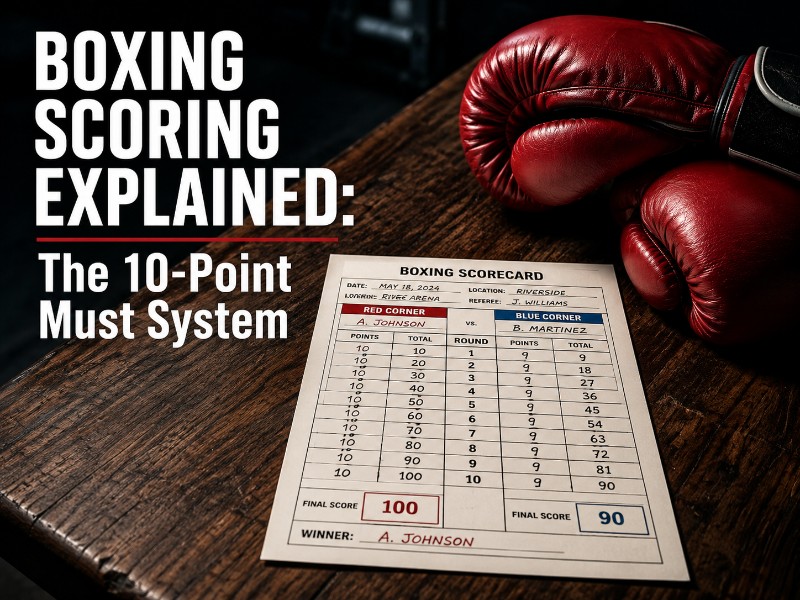
The system sounds simple. The winner of a round gets 10 points. The loser gets 9 or fewer. But once championship rounds, knockdowns, point deductions, and razor-close exchanges enter the picture, scoring becomes layered and deeply subjective.
Understanding how boxing is scored changes the way fights look on television. You stop chasing crowd reactions and start noticing ring positioning, punch accuracy, defensive footwork, and momentum swings. Suddenly, a slow-paced tactical fight between elite technicians becomes far more interesting than a sloppy brawl.
The Nevada State Athletic Commission, the Association of Boxing Commissions (ABC), and sanctioning bodies like the WBC, WBA, IBF, and WBO all operate within this framework. Ringside judges apply the same core principles whether the fight happens in Madison Square Garden, Atlantic City, or a packed arena on the Las Vegas Strip.
And yes, scoring also moves betting markets. One close round can swing millions of dollars in wagers during a major pay-per-view main event.
The Origins of the 10-Point Must System
The history of boxing scoring in the United States looks messy before it looks organized.
Early professional fights often relied on newspaper decisions. Reporters at ringside effectively decided who won after the final bell. Some states banned official verdicts altogether, which created bizarre outcomes where fans celebrated victories that never appeared in official records.
That changed as state athletic commissions expanded regulatory control.
The New York State Athletic Commission became one of the earliest major governing bodies to standardize professional scoring. Madison Square Garden helped popularize modern judging practices during boxing’s golden eras, especially during the rise of heavyweight stars like Muhammad Ali.
By the mid-20th century, the 10-Point Must System became the dominant framework across American boxing governance.
The Association of Boxing Commissions later helped unify scoring criteria nationwide. Sanctioning organizations such as the WBO, WBC, WBA, and IBF adopted similar judging standards to reduce inconsistency between jurisdictions.
Here’s the important distinction: the 10-point structure standardized math, not interpretation.
Judges still needed to evaluate action in real time. That subjective layer remains the source of most controversy today.
Earlier Boxing Scoring vs. Modern Scoring
| Era | Scoring Method | Main Problem | Modern Difference |
|---|---|---|---|
| Early 1900s | Newspaper decisions | No unified authority | Official judges now decide fights |
| Mid-century | State-specific systems | Inconsistent criteria | ABC unified rules improved consistency |
| Modern era | 10-Point Must System | Subjective interpretation | Standardized scoring framework |
Modern scoring feels cleaner on paper. In practice, close rounds still produce chaos.
Core Rules of the 10-Point Must System
The boxing scoring system explained in its simplest form works like this:
- Round winner receives 10 points
- Round loser receives 9 points or fewer
- Judges score each round independently
- Total points determine the winner after the fight
Most rounds end 10-9.
If Fighter A lands cleaner punches and controls distance better, that fighter usually earns the round. Even if the margin feels tiny.
Knockdowns change the equation immediately.
A fighter who scores a knockdown often wins the round 10-8. Multiple knockdowns can create 10-7 rounds. Referees can also deduct points for fouls, including low blows, holding, rabbit punches, or intentional headbutts.
Common Round Scores
| Round Type | Typical Score |
|---|---|
| Competitive round | 10-9 |
| Knockdown round | 10-8 |
| Two knockdowns | 10-7 |
| Point deduction involved | Variable |
| Even round | 10-10 (rare) |
The referee plays a critical role here. Ringside judges score the action, but referees enforce fouls and announce deductions.
That distinction matters during championship bouts.
A fighter can technically win exchanges yet still lose the round after a deduction for repeated infractions. Fans often miss that detail while watching live broadcasts because commentary teams focus heavily on momentum instead of arithmetic.
And momentum can be deceptive.
The Four Official Scoring Criteria in U.S. Boxing
Professional boxing scoring rules in the United States revolve around four official criteria recognized by the Association of Boxing Commissions.
Clean Punching
Clean punching carries the most weight.
Judges reward punches that land flush with the knuckle portion of the glove on legal scoring areas. Gloves hitting arms, shoulders, or elbows usually don’t count for much visually, even if the crowd reacts loudly.
This explains why slick counterpunchers consistently outperform volume punchers on scorecards.
Floyd Mayweather Jr. built an entire career around precision. Canelo Álvarez often wins rounds through compact combinations that land visibly harder than his opponent’s higher-volume attacks.
CompuBox statistics help television audiences track punch totals, but judges don’t score fights strictly by numbers.
A fighter landing 15 sharp counters can beat another fighter throwing 40 partially blocked punches.
Effective Aggression
Aggression alone means almost nothing.
Effective aggression matters.
Walking forward while absorbing jabs and counters doesn’t win rounds consistently. Judges reward pressure only when it creates successful offense.
This distinction confuses casual viewers constantly during pay-per-view fights.
Ring Generalship
Ring generalship reflects control.
The fighter dictating pace, positioning, and geography inside the ring usually gains an advantage. Cutting angles, forcing exchanges, controlling distance, and managing tempo all fit this category.
Elite fighters often manipulate rounds quietly. That subtle control rarely trends on social media clips, but judges notice it.
Defense
Defense includes slipping punches, blocking effectively, rolling shots, and avoiding sustained damage.
Defensive footwork matters heavily in high-level fights.
Now, here’s the interesting part. Defensive fighters frustrate audiences because missed punches don’t generate excitement. Yet judges still reward that skill. A fighter making an opponent miss repeatedly can absolutely win rounds with fewer punches landed.
Knockdowns, Deductions, and 10-8 Rounds
A knockdown changes the emotional temperature of a fight instantly. It also changes the math.
Under the 10-point must system rules, a clean knockdown usually produces a 10-8 round. That single moment can erase several close rounds on the scorecards.
Not every 10-8 round involves a knockdown, though.
Some commissions and judges allow discretionary 10-8 rounds when one fighter dominates overwhelmingly without scoring a knockdown. The Nevada State Athletic Commission permits that interpretation under modern judging guidelines.
Those rounds remain controversial because judges apply them inconsistently.
Fouls and Point Deductions
Referees can deduct points for:
- Low blows
- Holding
- Hitting behind the head
- Intentional headbutts
- Excessive clinching
An intentional foul can reshape an entire championship fight.
A fighter ahead 87-84 suddenly falls behind after a deduction. Betting odds swing immediately. Corners panic. Commentary teams start recalculating every close round.
That pressure intensifies during pay-per-view main events because title fights often reach the championship rounds where fatigue amplifies mistakes.
Knockdown Scenarios
| Scenario | Likely Score |
|---|---|
| Fighter wins round clearly | 10-9 |
| Fighter scores one knockdown | 10-8 |
| Fighter scores two knockdowns | 10-7 |
| Dominant round without knockdown | Possible 10-8 |
| Point deduction applied | Adjusted scoring |
Standing eight counts appear in some amateur formats, but professional boxing in most U.S. jurisdictions does not use them.
How Judges Fill Out Scorecards
Ringside judges work independently. No collaboration exists during the fight.
Each judge tracks rounds separately using official scorecards provided by the athletic commission overseeing the event. In Las Vegas, the Nevada State Athletic Commission supervises that process. In California, the California State Athletic Commission handles administration.
Judges sit at different angles intentionally.
One side of the ring might show blocked punches clearly while another angle obscures them. That alone explains some scoring variation.
Decision Types Explained
| Result | Meaning |
|---|---|
| Unanimous decision | All three judges pick the same winner |
| Split decision | Two judges favor one fighter, one favors the other |
| Majority decision | Two judges favor one fighter, one scores a draw |
| Draw | Even totals determine no winner |
A split decision doesn’t automatically mean corruption or incompetence. Sometimes close fights genuinely look different from separate viewpoints.
Still, scorecard transparency remains a major issue in American boxing.
Some states release round-by-round tallies quickly. Others move slower. Fans now expect immediate access during major broadcasts because sports culture increasingly demands transparency.
And honestly, delayed scorecards tend to create even more suspicion.
Championship Fights vs. Non-Title Fights
Championship boxing scoring carries more pressure because title fights usually last 12 rounds instead of 10.
Those extra rounds matter strategically.
A fighter losing early can still recover late. Veterans often conserve energy specifically for rounds nine through twelve because championship rounds historically separate elite conditioning from ordinary conditioning.
Sanctioning bodies like the WBC, WBA, IBF, and WBO also increase scrutiny around title defenses. Every controversial decision becomes headline material.
Undercard fights rarely receive that level of examination.
Main events generate replay breakdowns, media scorecards, betting controversy, and endless online debate. Judges know that reality entering the arena.
Comparison: Title Fights vs. Non-Title Fights
| Category | Championship Fight | Non-Title Fight |
|---|---|---|
| Length | 12 rounds | Usually 10 rounds |
| Stakes | Titles and rankings | Career positioning |
| Media pressure | Extremely high | Moderate |
| Betting volume | Massive | Lower |
| Scorecard scrutiny | Intense | Limited |
Championship scoring also rewards pacing intelligence.
Elite fighters understand that stealing one close late round can outweigh earlier inactivity.
Common Scoring Controversies in U.S. Boxing
Close rounds create controversy. Always have. Probably always will.
The phrase “boxing robbery” appears after nearly every major split decision because scoring remains subjective despite standardized rules.
CompuBox numbers complicate things further.
Fans often treat punch statistics like definitive proof, but judges evaluate impact, defense, ring control, and effective aggression simultaneously. A fighter landing more punches can still lose convincingly on official scorecards.
Crowd bias also affects perception.
A loud arena reacts dramatically to aggressive pressure fighters. Counterpunchers often work quietly. Television commentary can reinforce those emotional swings unintentionally.
Media unofficial scorecards influence public opinion too.
If six analysts score a fight for Fighter A but judges pick Fighter B, controversy explodes instantly across social media and sports talk shows.
Why Fans Disagree With Judges
| Factor | Impact |
|---|---|
| Crowd noise | Influences perception |
| TV commentary | Shapes audience reactions |
| Camera angles | Hide or exaggerate punches |
| Punch stats | Lack context |
| Subjective criteria | Create interpretation differences |
The appeals process rarely overturns decisions unless procedural misconduct exists. Athletic commissions generally protect judges’ discretion unless corruption or rule violations emerge.
Amateur vs. Professional Boxing Scoring
Amateur boxing and professional boxing look similar visually, but the scoring priorities differ significantly.
USA Boxing and Olympic boxing historically emphasized punch counts and clean contact over damage or ring control. Older amateur systems even relied on computerized scoring where judges pressed buttons after seeing scoring blows.
Professional boxing values effectiveness more heavily.
A hard counter that visibly changes momentum often outweighs several light touches in professional scoring.
Amateur vs. Pro Boxing Scoring
| Element | Amateur Boxing | Professional Boxing |
|---|---|---|
| Focus | Punch quantity | Effective offense |
| Fight length | Shorter | Longer |
| Protective headgear | Previously common | Not used |
| Scoring style | Technical point emphasis | Subjective round scoring |
| Pace | Fast output | Tactical pacing |
Olympic-style scoring rewards speed and activity. Professional scoring rewards control, damage, defense, and tactical execution over longer stretches.
That transition challenges many elite amateurs entering the pro ranks.
How Fans Can Score a Fight at Home
Learning how to score a boxing match changes the viewing experience completely.
Watching casually feels emotional. Watching with a scorecard feels analytical.
A simple method works best:
- Score each round immediately.
- Avoid changing earlier rounds emotionally.
- Focus on clean punching first.
- Ignore crowd reactions.
- Track momentum carefully late in rounds.
Muting commentary during close fights helps more than most fans expect. Broadcast teams naturally create narratives, especially during dramatic exchanges.
Helpful Tools for Home Scoring
| Tool | Purpose |
|---|---|
| Boxing scoring apps | Track rounds digitally |
| CompuBox stats | Compare punch totals |
| Round notes | Record close exchanges |
| Betting odds | Monitor momentum shifts |
Watching on ESPN, DAZN, or Showtime Boxing with independent scoring turns average fight nights into deeper tactical experiences.
And yes, scorecards become more sympathetic toward judges after a few difficult close rounds. That realization hits hard during technical fights with minimal clean offense.
The Role of Technology in Modern Boxing Scoring
Technology now shapes boxing broadcasts heavily, even if judges still rely primarily on human observation.
CompuBox statistics dominate television graphics. Punch totals scroll across screens constantly during DAZN and ESPN broadcasts.
But CompuBox has limitations.
Human operators track punches manually in real time. Errors happen. Glancing shots occasionally count while clean body work gets missed entirely.
Artificial intelligence scoring systems continue gaining attention, though resistance remains strong within traditional boxing circles.
Supporters believe AI could reduce bias. Critics argue boxing contains too much nuance for pure statistical modeling.
A perfectly timed counterpunch carries emotional and physical impact that raw punch totals often fail to capture.
Modern Technology in Boxing Scoring
| Technology | Function | Limitation |
|---|---|---|
| CompuBox | Punch statistics | Human tracking errors |
| Instant replay | Review fouls | Limited use in scoring |
| Digital scorecards | Faster tallying | Doesn’t remove subjectivity |
| AI analytics | Pattern evaluation | Lacks human context |
Transparency demands continue growing.
Fans want open scoring, replay reviews, and greater accountability after controversial decisions. Athletic commissions move cautiously because too much mid-fight information could alter fighter strategy unnaturally.
State Athletic Commissions and Oversight in the U.S.
State athletic commissions regulate professional boxing in America. No single national authority controls everything.
The Nevada State Athletic Commission remains the sport’s most influential regulator because Las Vegas hosts many major fights. The California State Athletic Commission and New York State Athletic Commission also carry enormous influence.
These commissions license judges, referees, inspectors, and officials.
The Muhammad Ali Boxing Reform Act added federal protections around rankings, contracts, and transparency, though states still maintain direct oversight of scoring administration.
Key Oversight Responsibilities
- Judge licensing
- Regulatory compliance
- Appeal procedures
- Scorecard review
- Event supervision
The Association of Boxing Commissions helps unify standards nationally, but scoring interpretation still varies slightly between jurisdictions.
That inconsistency frustrates fighters, trainers, bettors, and fans alike.
Strategic Implications: Fighting to Win on the Scorecards
Elite fighters understand scoring deeply. Great fighters manipulate it.
Floyd Mayweather Jr. mastered round stealing through late counters and defensive control. Canelo Álvarez excels at compact combinations that leave visual impressions with judges.
Those tactics matter because close rounds often decide championship fights.
Volume punchers push pace aggressively to overwhelm opponents statistically. Counterpunch specialists wait for mistakes and prioritize clean accuracy over output.
Common Tactical Approaches
| Style | Scoring Advantage |
|---|---|
| Volume punching | Activity and aggression |
| Counterpunching | Clean punching efficiency |
| Defensive shell | Reduced opponent success |
| Pressure fighting | Ring control potential |
Late-round surges frequently influence judges psychologically too.
A fighter finishing strongly can create momentum that shapes perception during razor-close exchanges. Smart veterans understand that dynamic instinctively.
Risk management also changes in fights with large betting implications. A fighter ahead on unofficial scorecards often shifts toward safer defensive movement instead of exchanging recklessly.
That approach frustrates audiences sometimes. It also wins championships.
Conclusion
The 10-Point Must System defines modern professional boxing in the United States. Every title fight, split decision, controversial scorecard, and dramatic championship comeback flows through that structure.
At first glance, the system appears mathematical. In reality, it blends scoring criteria with human interpretation, pressure, and perspective.
That tension explains why boxing debates never disappear.
One judge values defensive footwork more heavily. Another prioritizes aggression. Fans watching from home react emotionally to crowd noise, commentary, or dramatic moments. Meanwhile, ringside judges score rounds independently under intense scrutiny.
Understanding how judges score boxing transforms the sport from pure violence into layered strategy.
Clean punching. Effective aggression. Ring generalship. Defense.
Those four ideas shape careers, championships, betting markets, and boxing history itself. And once those details become visible during a fight, scorecards stop feeling random.
They start feeling human.