

A lot of buyers don’t think much about foam until something starts hurting. A football helmet feels too stiff after a long practice. A couch cushion collapses after two summers in a humid Texas living room. An office chair loses support halfway through another remote-work marathon. That’s usually the moment foam technology stops sounding boring.
In the American market, the debate around IMF padding vs layered foam keeps growing because products now face higher expectations. Consumers want impact absorption, durability, comfort, and long-term value at the same time. Sports leagues demand stronger safety compliance. Automotive brands chase lighter materials with better energy dispersion. Furniture shoppers expect cushions to stay supportive for years, not months.
And honestly, foam construction changes everything.
Injection molded foam comparison discussions typically focus on helmets, automotive seating, protective gear, and premium furniture. Layered foam construction dominates mattresses and comfort-focused products. Each design solves a different problem, which explains why manufacturers like Under Armour, Ford Motor Company, Tempur Sealy, and Bauer Hockey continue investing heavily in foam engineering.
What Is Injection Molded Foam (IMF) Padding?
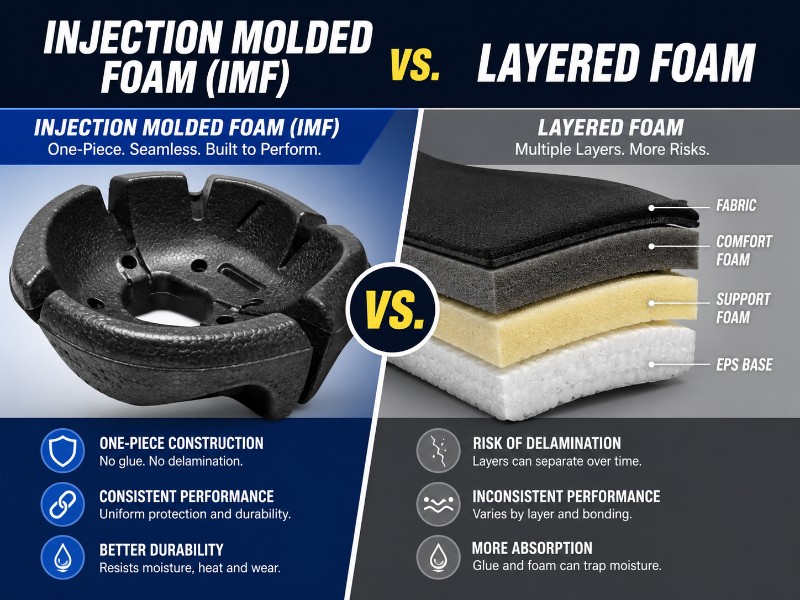
Injection molded foam padding is a single-piece foam structure created through high-pressure molding. Materials like Expanded Polypropylene (EPP) or Expanded Polystyrene (EPS) are heated, expanded, and thermally bonded inside a mold to create a uniform shape with consistent density.
That single-piece build matters more than most marketing copy admits.
Traditional layered padding contains separate foam sections bonded together with adhesive bonding techniques. IMF foam structure eliminates those seams. The result is a monocoque structure with stronger structural integrity and more reliable impact absorption across the entire impact zone.
In real-world use, molded helmet foam tends to maintain shape longer because there are fewer weak points where separation can happen.
How IMF Manufacturing Works
The IMF manufacturing process usually follows four steps:
| Step | Process | Functional Benefit |
|---|---|---|
| Material Expansion | EPP or EPS beads expand with steam | Creates closed-cell foam structure |
| Mold Injection | Foam enters a precision mold | Forms exact geometry |
| Thermal Bonding | Heat fuses particles together | Improves durability rating |
| Cooling & Finishing | Foam hardens into final shape | Maintains structural consistency |
NFL helmet manufacturers and companies like Bauer Hockey rely heavily on injection molded foam because impact resistance remains more predictable during repeated collisions.
Ford Motor Company also uses molded foam vs traditional foam designs in vehicle interiors because energy absorption rates remain stable under pressure and heat exposure.
Typical IMF Product Pricing
Premium IMF products generally cost more upfront.
- Entry-level IMF helmets: roughly $80–$150
- Premium football helmets: roughly $250–$400
- Automotive molded seating systems: significantly higher than layered alternatives
- High-end protective gear: usually 20%–40% more expensive than layered competitors
That price jump can feel aggressive at first glance. But durability changes the long-term math pretty quickly.
What Is Layered Foam Construction?
Layered foam padding uses multiple foam densities stacked together to balance softness, support, and pressure relief. One layer may focus on contouring while another acts as a support core.
This setup dominates American furniture and mattress markets for one reason: comfort.
Memory foam systems from Tempur Sealy or layered cushion foam designs from La-Z-Boy create a softer cushioning response that most consumers immediately notice in showrooms. IKEA USA also uses multi-layer foam construction heavily because it allows flexible pricing across different product tiers.
How Layered Foam Systems Work
Most layered foam systems combine:
- Open-cell structure comfort layers
- Medium-density transition foam
- High-density support core foundations
- Adhesive bonding between layers
That layering strategy helps spread pressure across larger surface areas. In practice, your shoulders sink slightly while lower layers maintain posture support.
For couches, mattresses, and office seating, layered foam softness usually feels more inviting than IMF comfort level designs.
But there’s a tradeoff.
Adhesive bonding points can weaken over time, especially under humidity exposure or repeated compression fatigue.
Common Price Ranges
Layered foam products cover a huge pricing spectrum:
| Product Type | Budget Range | Premium Range |
|---|---|---|
| Couch cushions | $50–$200 | $500+ |
| Mattresses | $300–$900 | $2,500+ |
| Sports padding | $40–$120 | $200+ |
| Office chairs | $100–$350 | $1,000+ |
That flexibility explains why layered foam construction dominates mass-market retail channels like Walmart and Target.
Durability and Longevity Comparison
Here’s where IMF usually pulls ahead.
Single-piece injection molded foam padding resists compression set more effectively than layered systems. Over time, layered foam wear becomes noticeable because separate layers compress at different rates.
Consumer Reports testing repeatedly shows that lower-density polyurethane foam tends to soften unevenly after prolonged use. Heat and humidity make that problem worse.
In states like Texas and Florida, foam breakdown accelerates because trapped moisture weakens adhesive bonding. California’s dry climate creates fewer humidity problems, although UV exposure can still reduce lifespan expectancy.
IMF Lifespan vs Layered Foam Wear
| Factor | IMF Padding | Layered Foam |
|---|---|---|
| Compression fatigue | Low | Moderate to high |
| Structural consistency | Excellent | Varies by quality |
| Humidity resistance | Strong | Moderate |
| Replacement frequency | Lower | Higher |
| Impact retention | Stable over time | Can decline unevenly |
Youth Football Alliance equipment managers often replace layered foam pads more frequently because repeated impacts create dead zones inside the foam.
IMF lifespan tends to remain more stable because the material behaves as one integrated shell instead of separate sections.
And that consistency matters after a few seasons. A helmet that feels identical in August and November offers a completely different experience than one that slowly softens in random areas.
Safety and Impact Protection
Safety discussions around foam shock absorption usually favor IMF designs, especially for high-impact sports and automotive use.
The reason comes down to force distribution.
IMF impact protection spreads energy more evenly across the foam structure. Layered foam safety systems can absorb impacts effectively too, but performance varies depending on foam density transitions and adhesive durability.
The National Highway Traffic Safety Administration (NHTSA) and ASTM International both emphasize measurable shock attenuation standards for helmets, child safety seats, and automotive interiors.
Why IMF Performs Better in High-Impact Situations
Closed-cell IMF structures typically provide:
- Faster energy dispersion
- Lower deformation rates
- Better impact resistance consistency
- More predictable rebound rate
- Reduced compression fatigue
Riddell and Schutt Sports both use advanced molded helmet foam systems because concussion prevention relies heavily on controlled energy absorption rates.
The CDC continues highlighting the importance of proper helmet fit and impact management in youth sports. Foam construction directly affects that equation.
Helmet Foam Comparison
| Safety Feature | IMF Padding | Layered Foam |
|---|---|---|
| Energy absorption rate | High | Moderate to high |
| Force distribution | Consistent | Variable |
| Structural integrity | Strong | Depends on bonding |
| ASTM compliance performance | Excellent | Good |
| Repeated impact durability | Strong | Moderate |
For motorcycle helmets, football helmets, and automotive crash padding, IMF vs layered foam guide comparisons almost always lean toward molded systems for pure protection.
Not softer. Just safer under repeated force.
Comfort and Ergonomics
Comfort changes the conversation completely.
Layered foam softness usually wins during first impressions because contouring feels more luxurious. Memory foam comfort layers create pressure mapping effects that reduce tension around shoulders, hips, and lower backs.
That’s why Tempur-Pedic products dominate premium mattress discussions.
Herman Miller office chairs also use layered ergonomic foam design principles because remote workers spend 6–10 hours daily in seated positions. Cushioning response matters more in that environment than maximum impact resistance.
IMF Comfort Level vs Layered Foam Softness
IMF padding feels firmer and more responsive. Some users describe it as “athletic” support rather than plush comfort.
Under Armour training gear and NBA protective equipment often prioritize rebound rate and ergonomic fit instead of softness because athletes need stability during movement.
Layered foam, meanwhile, adapts better to body contours.
That softer feel tends to win inside homes. It also explains why layered foam dominates recliners, couches, and mattresses despite lower durability ratings.
Comfort Comparison Table
| Comfort Factor | IMF Padding | Layered Foam |
|---|---|---|
| Firmness | Firm | Soft to medium |
| Pressure relief | Moderate | Excellent |
| Contouring | Limited | Strong |
| Rebound speed | Fast | Slower |
| Athletic support | Excellent | Moderate |
In practice, most buyers immediately notice layered foam comfort. IMF benefits usually appear later — after months or years of use.
Cost Comparison in the U.S. Market
IMF padding cost remains higher because manufacturing complexity increases production expenses. Precision molds, thermal bonding systems, and advanced EPP materials all raise manufacturing cost.
Layered foam price structures stay lower because production scales easily.
Foam Cost Comparison
| Product Category | Layered Foam | IMF Padding |
|---|---|---|
| Youth football helmet | $40–$80 | $150–$300 |
| Premium motorcycle helmet | $120–$250 | $300–$700 |
| Office chair cushion | $80–$200 | $250–$600 |
| Automotive seating | Moderate | High |
Dick’s Sporting Goods and Bauer Hockey product lines show this gap clearly. Premium molded foam pricing often targets buyers prioritizing long-term investment over entry-level affordability.
And honestly, that value proposition makes sense for high-impact products.
A $300 helmet lasting five years with stable impact resistance may cost less per season than replacing cheaper layered models repeatedly.
Furniture gets trickier. Many consumers simply prefer the softer feel of layered cushion systems despite shorter lifespan expectancy.
Environmental and Sustainability Factors
Sustainability conversations around foam materials have become much louder across the U.S. market.
Expanded Polypropylene (EPP) gives IMF systems a major advantage because recyclable molded foam options exist at larger scales. Layered foam recycling remains difficult because glued materials are harder to separate during processing.
The Environmental Protection Agency (EPA) and California Air Resources Board continue pressuring manufacturers to reduce VOC emissions and improve material lifecycle efficiency.
Sustainability Comparison
| Environmental Factor | IMF Padding | Layered Foam |
|---|---|---|
| Recyclability | Strong with EPP | Limited |
| Waste reduction | Better precision molding | More scrap waste |
| VOC emissions | Lower in some systems | Higher with adhesives |
| Carbon footprint | Moderate | Moderate to high |
Brands like Patagonia and REI increasingly favor sustainable foam materials with lower environmental impact.
That trend isn’t slowing down.
Consumers now ask tougher questions about waste reduction and long-term durability because replacing products every two years creates its own environmental cost.
Which Should You Choose? IMF vs. Layered Foam for Different Uses
The best foam padding type depends entirely on the use case.
That answer sounds annoyingly simple. Still true.
Best Foam for Helmets
For football helmets, motorcycle helmets, hockey helmets, and automotive safety systems, IMF impact protection usually delivers better performance.
Riddell, NFL equipment standards, and NHTSA safety expectations all push manufacturers toward stronger impact resistance and reliable energy dispersion.
For high-impact environments:
- IMF padding performs better
- Structural integrity lasts longer
- Compression fatigue stays lower
Best Foam for Furniture
For couches, recliners, mattresses, and office chairs, layered foam construction generally feels more comfortable.
La-Z-Boy and Tempur Sealy continue dominating comfort-focused categories because layered pressure relief simply feels better during long sitting sessions.
For home comfort:
- Layered foam feels softer
- Contouring improves relaxation
- Pressure mapping reduces stiffness
Best Choice by Buyer Type
| Buyer Priority | Better Option |
|---|---|
| Maximum safety | IMF Padding |
| Long-term durability | IMF Padding |
| Budget pricing | Layered Foam |
| Plush comfort | Layered Foam |
| Eco-conscious purchasing | IMF with EPP |
| Athletic performance | IMF Padding |
Conclusion
IMF padding vs layered foam isn’t really about one technology being universally superior. The better choice depends on whether durability, impact resistance, comfort, or price matters most in daily use.
Injection molded foam comparison results consistently favor IMF for helmets, automotive protection, and performance gear because single-piece construction delivers stronger structural consistency and safer energy absorption. Layered foam construction dominates furniture and bedding because comfort layers create a softer, more adaptive experience.
Most American consumers eventually land somewhere between those two priorities.
Protection and longevity usually point toward IMF. Comfort and affordability usually lean toward layered foam.
And after enough hours spent inside a helmet, car seat, office chair, or couch cushion, foam technology stops feeling invisible. You notice every inch of it.