

Walk into any boxing gym on a Tuesday night—not a fancy boutique studio, just a regular gym with a few bags hanging and the smell of leather and old sweat—and look at what people are actually wearing. Chances are, you’ll spot RDX logos more than anything from Cleto Reyes or Grant. That’s not an accident.
RDX is everywhere in American gyms right now. Not because of aggressive marketing or celebrity endorsements. More because they landed in the right price bracket at the right time, and enough people found out they didn’t fall apart after two months of real use.
So the actual question—the one worth answering—is whether they’re worth buying for your training. Not for a professional. Not for someone who already owns five pairs of gloves. For someone who trains 3–4 times a week, hits the bag, does some mitt work, maybe spars occasionally.
Short answer: yes, for $40–$100, RDX gloves hold up well enough that most people won’t feel the need to upgrade for a long time. But there are some things to know before picking a model.
Why RDX Keeps Showing Up in U.S. Gyms
The timing matters here. Between 2020 and 2022, home fitness equipment purchases in the U.S. jumped roughly 35%, according to Statista. Boxing specifically caught a wave—people wanted a workout that didn’t require a membership, and punching something is genuinely satisfying. Demand for gloves spiked. Most premium brands couldn’t serve a customer who needed something under $80 that would survive daily garage sessions.
RDX could.
The average recreational boxer in the U.S. trains 2–4 times a week, wants gloves that last, and isn’t willing to spend $200 to find out if they’ll stick with the sport. RDX fits that profile almost perfectly. Here’s how they stack up against the other options in that market:
| Brand | Price Range (USD) | Best For | Real-World Feel |
|---|---|---|---|
| RDX | $40–$100 | Beginners / Intermediate | Practical, durable, slightly rough at the edges |
| Everlast (mid-tier) | $80–$150 | Casual to intermediate | Decent but inconsistent across their lineup |
| Cleto Reyes | $150–$250+ | Advanced / Pro | Premium padding, long break-in, built to last years |
You’re not buying prestige when you go with RDX. You’re buying functionality that holds up longer than the price suggests—and that distinction starts to matter once training becomes a regular habit instead of something you do when you feel like it.
Build Quality and Materials: What You Actually Feel
Material quality sounds like a dry topic until your gloves start cracking at the thumb seam three months in. Then it becomes the only topic.
RDX uses two main exterior materials, and the difference between them is noticeable from the first session:
Maya Hide Synthetic Leather
This is what you get on most of the budget-end RDX models. It has a slightly rubbery texture—not unpleasant, but you’ll notice it’s not real leather. Some people report a faint squeaking sound during certain movements early on; it fades with use. The material resists moisture reasonably well and doesn’t deteriorate as fast as cheaper synthetics from lesser-known brands. For beginners, it’s fine. It’s not luxurious. But it doesn’t disintegrate either.
Full-Grain Cowhide Leather
The step-up feels immediate. Softer, more natural, and noticeably more durable over time. If you’re training consistently, cowhide holds its structure better under repeated impact and is less prone to cracking around the knuckle seams. It’s closer to mid-range gloves that cost more—not elite-tier, but closer.
Most RDX models across both materials also include Shell Shock gel padding, EVA foam layers, a reinforced thumb attachment, and double-stitched seams. For under $100, that construction is solid. You’ll notice small imperfections—some stiffness out of the box, occasionally cramped finger compartments. Not deal-breakers, but worth knowing.
Padding and Protection: Do They Actually Save Your Knuckles?
This is where budget gloves usually fall apart—literally or figuratively. Too soft and your hands sink into the padding with no structure. Too stiff and every impact travels straight to your knuckle bones.
RDX sits in the middle, and it’s not accidental. Their protection stack typically includes Gel Efficax lining, Shell Shock padding, and a Quadro-Dome impact dispersion layer. In practice during bag rounds and mitt work, the padding feels controlled—not jarring. Knuckle soreness stays minimal after longer sessions, though not zero.
For sparring, 16 oz RDX gloves provide enough cushioning for beginner and intermediate training environments. Advanced fighters who’ve trained in higher-end gloves tend to notice the difference in padding density—premium brands like Winning or Cleto Reyes have a more refined, consistent feel that doesn’t compress as much over time. But for everyday training? RDX handles the workload.
Wrist Support and Fit: Where Most Budget Gloves Actually Fail
Wrist injuries from boxing don’t usually happen dramatically. They accumulate—a hook thrown at a slightly wrong angle, a session where your wrist alignment was off, a glove that didn’t lock the joint properly. By the time you feel something, the damage is already there.
RDX does better here than most gloves in this price range. The extra-long hook-and-loop Velcro strap wraps around fully and creates a genuinely locked-in feeling. During overhands and awkward punch angles, the wrist stays stable in a way that cheaper gloves don’t manage.
One thing to know: several RDX models run slightly tight in the hand compartment. If you use hand wraps—which you should—the fit can feel cramped. Sizing up tends to solve the problem, especially for sparring sessions where comfort compounds over time.
Ventilation and Sweat Control: The Real Gym Test
Any glove feels fine in the first ten minutes. The test is what happens in round six when your hands are soaked and you’re running warm-ups between combinations.
RDX uses mesh palm panels, a ventilation system they call S.P.P., and perforated airflow zones in most models. If you’re training in Texas or Florida in summer, your hands will still sweat—that’s just physiology. But what you’ll notice is that the gloves don’t trap heat the way fully enclosed alternatives do. Drying time after sessions is reasonable. Odor buildup stays manageable, assuming you actually air the gloves out between sessions. Skip that step consistently and no ventilation system in the world helps.
5 Best RDX Boxing Gloves
1. RDX Boxing Gloves for Training Muay Thai


Best for: Beginners on a budget
These are noticeably light from the first session—which is both a strength and a limitation. Light gloves are easier to work with when you’re still developing technique. They’re less useful once you’re doing heavy-contact sparring and need more padding density.
- Available in 8 oz to 16 oz
- Maya Hide exterior
- Quadro-Dome padding system
- Under $60 USD
What works: Lightweight feel, solid breathability for longer sessions, reliable wrist support for entry-level training, wide color options.
What doesn’t: Long-term durability isn’t strong enough for heavy daily use. Customer service response from RDX has been inconsistent.
For someone just starting out who needs a decent pair without committing $100+, these do the job without complicating the decision.
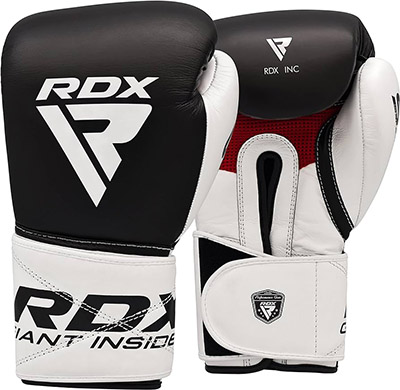
2. RDX Cowhide Leather Boxing Gloves
Best for: Overall value
This is where RDX starts feeling like a serious product. Full cowhide leather, Gel Efficax lining, reinforced stitching throughout. The difference from the synthetic models is apparent after a few sessions—the material molds slightly to your hand, the padding distributes impact more evenly.
- Full cowhide leather exterior
- Gel Efficax padding lining
- Reinforced stitching at stress points
What works: Noticeably more durable than the synthetic models. Better shock absorption on the bag. Stable, secure fit. Handles sparring well enough for intermediate-level training.
What doesn’t: The interior can feel slightly tight with wraps, particularly for wider hands.
These compete directly with $80–$100 gloves from bigger brands—and hold their ground.
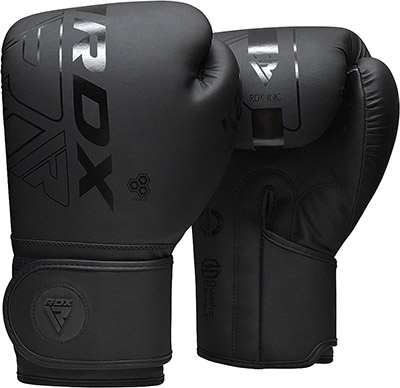
3. RDX Gloves for Training, Kickboxing & Muay Thai
Best for: Mixed discipline training
If your sessions rotate between boxing rounds, kickboxing drills, and Muay Thai combinations, most gloves built for one discipline start showing limitations in the others. These adapt reasonably well across all three.
- EVA-LUTION foam construction
- Cool-X mesh palm ventilation
- Attached thumb design for safety
What works: Strong impact resistance across different punch and kick combinations. Stable wrist alignment that holds across varied movements. Good crossover performance without feeling compromised in any one discipline.
What doesn’t: Limited design and color options compared to other RDX models.
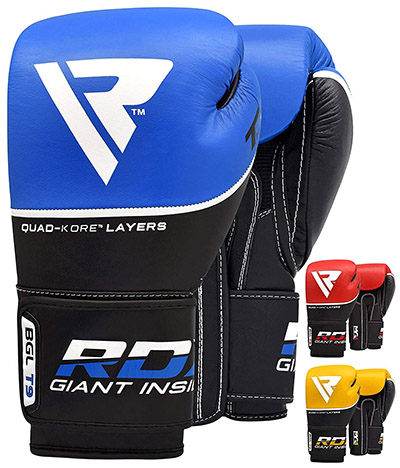
4. RDX Gel-Infused Boxing Gloves
Best for: Heavy bag work
The difference shows up after round four or five on a heavy bag—not round one. Gel-integrated padding disperses impact in a way that foam alone doesn’t, and you feel it in the cumulative knuckle soreness (or lack of it) at the end of a long session.
- Gel-integrated padding system
- Full-grain cowhide leather
- Thick wrist strap construction
What works: Durable under repeated bag impact. Comfortable padding distribution across the knuckle area. Lighter feel than the build quality suggests.
What doesn’t: Long-term durability depends heavily on training intensity. Daily high-volume sessions will wear them down faster than moderate use.
Particularly well-suited for garage gym setups where the bag gets hit consistently every session.
5. RDX Boxing Gloves Leather NOIR

Best for: Premium-style RDX option
RDX’s attempt at a more refined product—and it mostly works. The Maya Hide ConvEX leather has a different texture than their standard synthetic, the X-FOAM padding is denser, and the minimal design doesn’t look cheap in a gym setting.
- Maya Hide ConvEX leather exterior
- X-FOAM padding system
- Advanced wrist stabilization construction
What works: Stronger protection than the base models. Clean, minimal aesthetic. Excellent airflow for the padding density level.
What doesn’t: Snug fit—probably the tightest of the RDX lineup. Size up if you’re on the border.
For intermediate fighters who want something that feels closer to mid-tier without paying mid-tier prices, this is the one to look at.
RDX vs. Higher-End Gloves: What You Actually Notice
There’s always curiosity about what you get when you spend $200+. The differences are real—but they don’t always show up where people expect.
| Feature | RDX Gloves | $200+ Pro Gloves |
|---|---|---|
| Padding Feel | Balanced, slightly firm | Dense, refined, consistent throughout |
| Wrist Support | Strong Velcro-based system | Superior with lace-up options |
| Durability | 6–12 months with heavy use | 1–3 years with proper care |
| Comfort Over Time | Good, occasionally tight | Broken-in feel that improves with use |
| Price | $40–$100 | $200+ |
The biggest gap isn’t in round one. It’s in month eight. Premium gloves age better—the leather develops, the padding stays consistent, the fit improves as the glove breaks in. RDX holds up well for its price range, but it plateaus. For most people training 3–4 times a week, that plateau happens later than expected.
Buying Guide: Choosing the Right RDX Gloves
A few straightforward decisions narrow it down quickly.
Weight
- 12 oz — Pad work and speed drills; faster hand movement but less impact protection
- 14 oz — General training, a practical middle ground
- 16 oz — Sparring; required in most U.S. gym environments
Heavier gloves absorb more impact during sparring but slow hand speed slightly over longer rounds. Most gyms require 16 oz minimum for contact work.
Material
Maya Hide works for beginners or anyone on a tight budget. Cowhide leather is worth the slight price difference if you’re training consistently—the durability gap becomes noticeable after a few months.
Closure
Velcro closure is more practical for solo training—you can get in and out of the gloves without help. Lace-up systems offer a more custom fit but require another person to tighten properly. For most people, Velcro is the right call.
Ventilation
Mesh palms help with airflow, but they only matter if the gloves get aired out after each session. Leaving them in a bag for 24 hours undoes whatever ventilation system they have.
Frequently Asked Questions
Is RDX a good boxing brand?
RDX is a reliable mid-budget brand that consistently delivers on protection, durability, and wrist support for everyday training. It’s not matched to elite-level craftsmanship—but it performs consistently in real gym conditions, which is what matters for most people.
Should you get 14 oz or 16 oz gloves?
16 oz for sparring—most gyms require it, and the added padding matters when contact is involved. 14 oz for bag work, pad work, and general training where you want slightly more hand speed. If you can only buy one pair, 16 oz covers more situations.
How long do RDX gloves last?
With regular heavy use—four or more sessions per week—expect 6 to 12 months before the padding compresses noticeably. Light-to-moderate use (2–3 sessions per week) can extend that to 18 months or more, especially with the cowhide leather models.
Do RDX gloves run small?
Several models run slightly tight in the hand compartment, particularly with hand wraps. If you’re between sizes, sizing up tends to be the better call—especially for the NOIR and cowhide leather models.
Are RDX gloves good for sparring?
16 oz RDX gloves handle beginner and intermediate sparring well. Advanced fighters who’ve trained in higher-end brands will notice the difference in padding density and consistency over longer sparring sessions—but for recreational and intermediate use, they’re appropriate.
Final Verdict
A few months into regular training, the things that felt important at the beginning—brand recognition, how the gloves look on Instagram—stop mattering. What actually matters is how the wrist holds up in round eight, whether the padding has compressed to the point of being useless, whether the seams are still intact.
RDX delivers solid protection, reliable wrist support, and practical durability for under $100. They don’t claim to be anything they’re not. For beginners and intermediate fighters training 3–4 times a week, they handle the workload without requiring an early upgrade. For advanced fighters looking for precision, long-term aging quality, and elite-level padding consistency—there’s a ceiling here, and they’ll eventually hit it.
Most people hit that ceiling later than they expect.