

Most beginners obsess over shoulders, arms, and chest work. Heavy bench presses. Endless push-ups. Hours smashing the heavy bag until the knuckles ache. Then a leaner fighter with sharp hip rotation lands one clean cross, and suddenly the difference becomes obvious.
Punching power starts lower.
Your feet grip the floor. Your hips rotate. Your torso transfers force. The fist simply delivers the result. When the core fails to connect those pieces together, punches feel hollow. Fast sometimes, but not heavy.
That pattern shows up constantly in American boxing gyms. Coaches at Golden Gloves clubs, MMA facilities, and strength labs repeat the same correction over and over: rotate harder, brace tighter, stay connected.
A stronger core improves force transfer, balance, and resistance against fatigue. It also protects the lower back during long sessions on the mitts or heavy bag. According to research published by the National Strength and Conditioning Association (NSCA), rotational power and trunk stiffness directly influence striking velocity and force production [1].
And honestly, the difference becomes noticeable quickly. Punches start sounding different on the bag. Sharper. Less slapping. More snap behind the impact.
The Science Behind Core Exercises for Maximum Punching Power
A punch travels through what coaches call the kinetic chain. In plain language, force moves upward through connected body segments.
Feet drive into the ground. Hips rotate. The torso accelerates. The shoulder and arm finish the motion.
When one segment leaks energy, the entire sequence weakens.
That “energy leak” usually appears in predictable ways:
- Loose abdominal bracing during rotation
- Poor hip mobility
- Weak obliques
- Limited glute activation
- Bad posture under fatigue
A lot of recreational fighters train abs for appearance instead of function. Endless crunches build burn tolerance, but punching requires rotation, anti-rotation, and controlled stiffness under speed.
That distinction matters more than people expect.
One fighter can perform 200 sit-ups and still struggle generating torque. Another athlete with powerful rotational mechanics can produce frightening impact with far less visible muscle definition.
The body cares about transfer efficiency, not mirror aesthetics.
Rotational Core Exercises for Explosive Punching Power
Medicine Ball Rotational Throws
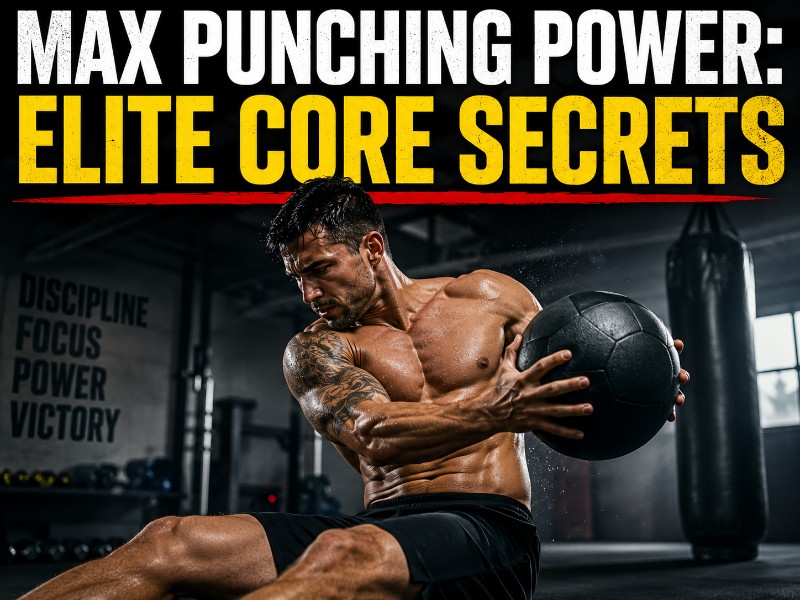
Medicine ball rotational throws come close to replicating real punching mechanics. The hips fire first, the torso follows, and the arms transfer momentum into the throw.
In practice, this exercise exposes weak sequencing almost immediately. Athletes who rotate too early lose power. Athletes who stay too upright struggle generating speed.
A 6–12 lb medicine ball works best for most people. Heavier loads often slow rotation too much.
Basic setup:
- Stand sideways near a wall
- Rotate aggressively through the hips
- Release explosively
- Reset completely between reps
Most high-level striking coaches prefer low reps with maximum intent:
| Training Variable | Recommended Range |
|---|---|
| Sets | 3–5 |
| Reps | 5 per side |
| Rest | 60–90 seconds |
| Weight | 6–12 lbs |
Rogue Fitness and Title Boxing medicine balls show up in a lot of American gyms because the grip texture holds up under repeated wall throws. Cheap rubber balls tend to bounce unpredictably after a few months.
That gets annoying fast.
Cable Woodchoppers
Cable woodchoppers build controlled rotational strength. The movement looks simple until fatigue arrives and the shoulders start taking over.
The important detail is deceleration.
Punching hard means stopping rotation efficiently too. Otherwise, balance disappears after combinations.
Cable woodchoppers help train:
- Oblique strength
- Rotational control
- Torso endurance
- Hip-to-shoulder sequencing
Moderate resistance usually works better than maximal loading. Once the movement slows down too much, the carryover to punching starts fading.
And that’s a common mistake in commercial gyms. People stack the cable machine like they’re trying to deadlift with their abs.
Anti-Rotation Exercises to Stabilize Punching Power
Pallof Press
The Pallof press rarely looks impressive. No explosive movement. No dramatic sweat puddle. Yet fighters who skip anti-rotation work often struggle maintaining punch structure under pressure.
When you throw a punch, your body fights against unwanted twisting forces. The Pallof press trains that resistance.
Execution matters more than weight:
- Press the handle away from the chest
- Resist torso rotation
- Keep ribs stacked over hips
- Breathe slowly during the hold
This exercise tends to humble stronger athletes. Especially lifters with big upper bodies but poor trunk stability.
Dead Bugs
Dead bugs sound harmless. The first few reps usually reinforce that assumption.
Then coordination starts breaking down.
Dead bugs improve spinal positioning and teach controlled limb movement while the torso stays stable. That translates surprisingly well to boxing footwork and defensive movement.
Heavy bag sessions often expose weak lower-back endurance. Dead bugs help clean that up without excessive spinal stress.
For athletes with recurring back tightness, this movement usually feels more productive than endless crunch variations.
Lower Ab and Hip Drive Movements
Hanging Leg Raises
Lower abdominal strength supports hip drive during hooks, uppercuts, and aggressive forward movement.
Hanging leg raises train:
- Lower abs
- Hip flexor control
- Grip endurance
- Pelvic positioning
Momentum ruins the exercise. Controlled reps matter more than high numbers.
A lot of fighters swing through the movement trying to hit 20 reps quickly. The abs stop working once the body turns into a pendulum.
Glute Bridges
Punching power depends heavily on hip extension. Strong glutes improve force production from the ground upward.
That connection becomes obvious during hard cross combinations.
Fighters with weak glutes often over-rotate through the lower back instead. Over time, the back absorbs stress the hips should handle.
Resistance-band glute bridges remain popular in American boxing gyms because they reinforce lateral hip activation while building extension strength.
Simple movement. Huge payoff.
Plank Variations for Bracing Strength
Planks train sustained tension. Not glamorous, but incredibly useful.
During later rounds, many fighters lose power because their torso stops stabilizing effectively. Punches still move fast, but impact weakens.
A strong plank foundation improves body control under fatigue.
The best variations include:
- Standard forearm plank
- Side plank
- Plank with shoulder taps
| Plank Variation | Main Benefit | Boxing Carryover |
|---|---|---|
| Forearm plank | Full-body bracing | Better punch stability |
| Side plank | Oblique endurance | Cleaner rotational control |
| Shoulder tap plank | Anti-rotation stability | Improved balance during combinations |
Breathing matters here. Fighters who hold their breath usually fatigue faster than expected.
Thirty to sixty seconds works for most training sessions. Longer durations sometimes become more mental than physical.
Russian Twists and Oblique Development
Russian twists divide opinions in combat sports circles. Some coaches love them. Others think they’re overused.
The truth sits somewhere in the middle.
Controlled Russian twists build rotational endurance and improve torso awareness. Sloppy twists with excessive speed mostly train momentum.
That distinction changes everything.
A medicine ball or light plate usually provides enough resistance. Heavy loading tends to pull the spine into awkward positions, especially when fatigue sets in late during circuits.
Strong obliques help stabilize violent rotational movement. They also reduce excessive strain during hooks and body shots.
And honestly, body punches feel different once rotational endurance improves. The hips stay connected deeper into rounds instead of fading after a few exchanges.
Programming Core Work for American Training Schedules
Most American adults train around three to five days per week. Between work schedules, commuting, and recovery demands, long specialty workouts become difficult to sustain.
Short, focused sessions usually work better.
A practical weekly structure looks like this:
| Day | Focus |
|---|---|
| Monday | Rotational power + heavy bag |
| Wednesday | Anti-rotation + conditioning |
| Friday | Medicine ball explosiveness |
Core work fits best after boxing rounds or strength sessions. Pre-fatiguing the torso before technical sparring sometimes reduces movement quality.
Twenty-minute sessions often outperform hour-long ab marathons simply because consistency stays higher.
That reality frustrates some people. There’s still a belief that punishment equals progress. Hundreds of reps. Endless circuits. Sweat everywhere.
But explosive athletes rarely train core endurance like punishment sessions. Most prioritize quality output and controlled fatigue.
Big difference.
Recovery, Nutrition, and Injury Prevention
Core muscles recover like any other muscle group. Hard rotational work creates fatigue through the obliques, lower back, and hip stabilizers.
Sleep matters more than most recreational fighters admit.
Seven to nine hours improves recovery quality, hormone regulation, and nervous system function [2]. Protein intake also influences repair and force production. Roughly 0.7–1 gram per pound of body weight works well for active athletes.
Hydration affects performance too. Even mild dehydration reduces power output during explosive movement.
Mobility work helps maintain rotational freedom:
- Foam rolling
- Hip mobility drills
- Thoracic spine rotations
- Dynamic warm-ups
Persistent pain deserves attention early. A small hip restriction can eventually alter punching mechanics enough to irritate the lower back or shoulder.
That chain reaction happens gradually. Then one day the body suddenly feels “off.”
Equipment and Home Gym Options in the US
A useful punching-power setup doesn’t require a luxury performance facility.
Plenty of fighters train effectively in garages, apartments, or small basement spaces.
Affordable options include:
| Equipment | Typical Price Range |
|---|---|
| Medicine ball | $30–$60 |
| Resistance bands | $15–$40 |
| Door-anchor cable system | $40–$120 |
Dick’s Sporting Goods, Amazon, and Title Boxing carry most beginner-friendly setups.
Resistance bands deserve more credit than they get. Cheap, portable, versatile. Not exciting, but extremely practical for rotational drills and anti-rotation work.
Meanwhile, oversized home gyms sometimes collect dust after the novelty fades. That happens more often than fitness influencers admit.
Common Mistakes That Reduce Punching Power
Several mistakes consistently limit striking force.
Training Only Visible Abs
Visible abs don’t guarantee functional rotation or bracing ability. Fighters often overemphasize aesthetics and undertrain movement quality.
Ignoring Hip Mobility
Tight hips restrict rotational speed. The torso compensates, usually through the lower back.
That compensation catches up eventually.
Overtraining Without Recovery
More volume isn’t automatically better. Constant soreness reduces explosiveness and slows reaction time.
Using Excessive Weight
Heavy resistance often destroys movement speed. Punching requires acceleration, not grinding.
Neglecting Footwork
Power starts at the floor. Weak foot positioning reduces force transfer before the punch even begins.
Power works like a chain. One weak link changes everything.
Measuring Progress in Punching Power
Progress becomes easier to notice once objective tracking enters the picture.
Useful indicators include:
- Heavy bag impact feedback
- Punch tracker data
- Medicine ball throw distance
- Combination speed consistency
- Speed bag rhythm under fatigue
FightCamp systems and similar punch trackers provide measurable speed and output data. Not perfect, but useful for trend tracking over several weeks.
Most meaningful improvements appear gradually. Around week four or six, punches often feel cleaner before they feel dramatically stronger.
That delay throws people off sometimes. The body usually improves coordination first, then output later.
FAQs About Core Exercises for Punching Power
How often should core exercises be trained for boxing?
Three focused sessions per week works well for most athletes. Daily high-volume ab circuits often create unnecessary fatigue without improving punching performance much.
Do crunches improve punching power?
Crunches help abdominal endurance slightly, but rotational and anti-rotation exercises transfer better to striking mechanics.
What is the best exercise for rotational punching power?
Medicine ball rotational throws consistently produce strong carryover because they mimic explosive hip rotation and torso acceleration.
Can stronger abs increase punching speed?
A stronger, more coordinated core improves force transfer and body control. That often increases punch speed indirectly.
Are planks useful for fighters?
Yes. Planks improve bracing endurance and postural stability during combinations and defensive movement.
Does heavy lifting improve punching power?
Heavy lifting can improve force production when combined with explosive rotational training. Strength alone rarely translates perfectly into striking power.
Final Takeaway: Building a Strong Core for Maximum Punching Power
Maximum punching power comes from efficient force transfer, not isolated arm strength.
Rotational exercises build explosive torque. Anti-rotation drills improve stability. Hip-focused movements connect lower-body drive into the punch itself. Then recovery ties everything together quietly in the background, which honestly gets overlooked more than almost anything else in combat sports.
The strongest punchers usually move efficiently before they look powerful.
That detail tends to surprise people. Especially during sparring. One athlete appears relaxed, almost casual, then the punch lands with strange heaviness behind it. Usually the difference lives in the hips, torso control, and timing — not oversized arms or endless crunches.
Train the core like a transfer system instead of a cosmetic project, and the change eventually shows up on the bag. Then in combinations. Then everywhere else.
Sources
[1] National Strength and Conditioning Association (NSCA) – Rotational Power and Athletic Performance Research
[2] National Sleep Foundation – Sleep Duration Recommendations for Athletic Recovery