
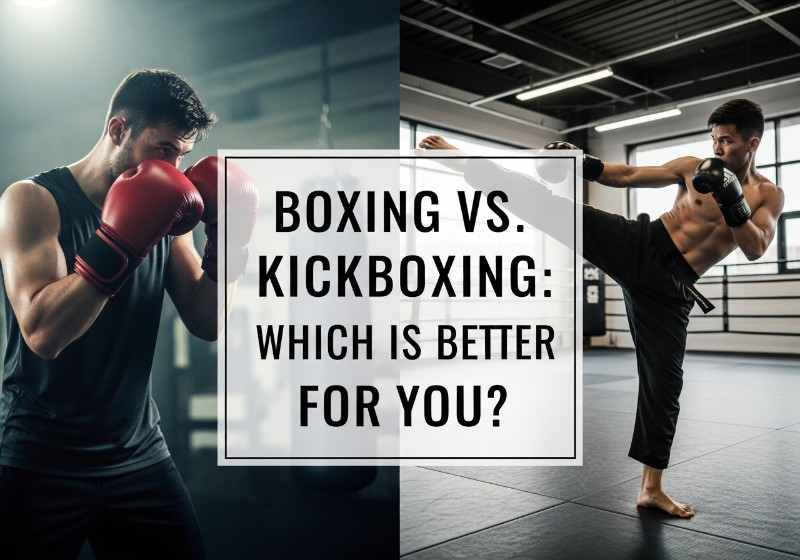

Walk into almost any combat sports gym across the United States right now and you’ll find at least two groups of people training side by side — boxers working the mitts with sharp, tight combinations, and kickboxers drilling roundhouse kicks with the kind of snap that makes the heavy bag shudder. Both sports are thriving. Both draw Americans for wildly different reasons.
The question of boxing vs. kickboxing comes up constantly — in gym lobbies, on fitness forums, in locker rooms. People want to know which is better for weight loss, which one’s more practical for self-defense, which costs less to get into. These are fair, practical questions that deserve real answers, not marketing fluff from a gym trying to sell memberships.
This guide breaks down exactly what separates the two sports — the rules, the techniques, how training actually feels in a U.S. gym setting, what you’ll spend, and how to figure out which one fits your goals. Whether you’re a complete beginner or someone cross-shopping after years in one discipline, there’s something useful here.
1. Core Rules and Scoring Systems
What’s Actually Legal in Each Sport
In boxing, it’s straightforward: punches to the head and body, nothing else. The sport is governed in the U.S. primarily through USA Boxing for the amateur side, while professional bouts fall under bodies like the World Boxing Council (WBC) and the World Boxing Association (WBA). A standard professional boxing match runs 12 rounds of three minutes each, with amateur bouts typically shorter.
Kickboxing is a broader category. Under the International Kickboxing Federation (IKF) and organizations like Glory — one of the premier kickboxing promotions in the world — fighters can throw punches and kicks, with some rulesets permitting knee strikes. Full-contact kickboxing rules require fighters to throw a minimum number of kicks per round, which changes the entire rhythm of a fight.
How Judges Score Each Sport
Both sports use the 10-point must system for professional competition — meaning the winner of a round gets 10 points, the loser gets 9 (or fewer if a knockdown occurs). The similarity ends there. In boxing, judges score based on clean punching, effective aggression, defense, and ring generalship. In kickboxing, powerful leg kicks and combination variety factor heavily into the scorecard.
Knockouts end fights in both sports. Technical knockouts (TKOs) happen when a referee stops the contest, or when a fighter’s corner throws in the towel. The standing eight count — where a referee pauses action to assess a hurt fighter — appears in some boxing rulesets but varies depending on the sanctioning body.
Boxing made it to the Olympic Games long ago, cementing its amateur infrastructure in ways kickboxing hasn’t yet matched at the international level.
2. Techniques and Fighting Styles
The Boxing Toolkit
Boxing distills striking down to four punches: the jab, the cross, the hook, and the uppercut. What sounds limiting actually produces extraordinary complexity. Floyd Mayweather Jr. built an undefeated Hall of Fame career on a jab-cross combination executed with surgical precision and a defensive guard that made him nearly untouchable. Muhammad Ali redefined what footwork could do — his pivot footwork and head movement set a blueprint that coaches still teach today.
In boxing, the guard is everything. Hands stay high, chin tucked, shoulders rotating to generate power. Defense and offense blur together.
What Kickboxing Adds
Kickboxing opens the arsenal significantly. The roundhouse kick — thrown with the shin, not the foot — is the signature weapon of the sport and, when landed to the thigh or ribs, accumulates damage in ways punches alone can’t. Front kicks, spinning back kicks, and in some rulesets, knee strikes in the clinch all become part of the equation.
Israel Adesanya, who built his striking in kickboxing before his UFC run, demonstrates what elite kickboxing looks like when timing, distance, and combination variety all come together. Joe Lewis, the legendary American full-contact pioneer, helped bring structured kickboxing into mainstream U.S. gyms in the 1970s, and that legacy still shows up in how American coaches approach the sport.
Footwork in kickboxing tends to be wider-based than boxing, partly to protect against leg kicks, partly to generate rotational power for the hips. Head movement matters less in kickboxing than in boxing — the threat of kicks changes how fighters manage distance.
3. Training Structure and Gym Experience (U.S.)
What a Typical Session Looks Like
Boxing training in the U.S. usually follows a rhythm that hasn’t changed much in decades: jump rope, shadow work, heavy bag drills, mitt work with a coach, and sparring toward the end of the session. Traditional boxing gyms — the kind affiliated with USA Boxing for amateur competition — tend to have a serious, focused culture. The conditioning circuits alone are humbling.
Kickboxing gyms run along a similar structure, with heavy bag drills and pad work taking center stage. The key difference is the inclusion of kicking technique drills, which take longer to develop than punching mechanics and require separate attention.
Fitness Kickboxing vs. Competitive Training
Here’s where it gets complicated for beginners. Brands like 9Round and Title Boxing Club — which has locations across the U.S. — offer group fitness classes inspired by boxing and kickboxing without the contact. These are great entry points. The classes are structured around HIIT formats, conditioning circuits, and personal training sessions. Everlast and Century Martial Arts stock the equipment most of these gyms use.
The YMCA often runs beginner-friendly boxing and kickboxing fitness programs as well, which tend to be lower-cost than boutique studios.
Competitive training is a different animal entirely. Sparring sessions, longer practices, and a coach who actually pushes skill progression — that’s what separates fitness-focused classes from true combat training.
4. Fitness Benefits and Calorie Burn
Numbers Worth Knowing
An hour of boxing training burns roughly 500 to 700 calories depending on intensity, body weight, and how hard you’re actually working. Kickboxing comes in slightly higher for many people — estimates from exercise physiology research put it at 600 to 800 calories per hour — because the full-body demand of throwing kicks activates more muscle groups simultaneously.
The American Heart Association recommends 150 minutes of moderate aerobic activity per week for cardiovascular health. One boxing or kickboxing class per week barely touches that. Two to three sessions hits the target comfortably.
Both sports deliver strong aerobic conditioning and anaerobic power development. The core engagement in each is significant — rotational punching mechanics demand constant abdominal activation, and kicks require hip stability throughout each repetition.
What tends to happen after a few months of consistent training is that people notice the stress relief more than the weight loss. The Centers for Disease Control and Prevention (CDC) has consistently noted that exercise reduces symptoms of anxiety and depression, and combat sports training — with its combination of physical exertion and skill focus — tends to have an outsized effect on mental clarity. There’s something about hitting a heavy bag after a rough week that cardio machines simply can’t replicate.
5. Self-Defense Applications
What These Sports Actually Prepare You For
Boxing builds pressure-tested defensive instincts. The ability to slip a punch, control distance, and throw accurate counters under stress transfers to real-world situations in ways that choreographed self-defense classes don’t. USA Boxing competitors, especially those with years of sparring experience, develop genuine reflexes.
Kickboxing adds leg kicks and the option to create distance with front kicks, which has practical value. The International Kickboxing Federation’s competitive structure develops fighters comfortable at multiple ranges.
That said, real-world self-defense involves context, situational awareness, and de-escalation tactics that neither sport formally teaches. Distance management and a defensive stance are useful starting points, but reaction time and the ability to avoid conflict entirely matter more. The National Crime Prevention Council consistently emphasizes awareness as the first line of defense.
Cross-training with MMA — the way UFC fighters often blend boxing and kickboxing with wrestling and grappling — gives a more complete picture. But for someone who wants effective striking skills without dedicating years to training, boxing tends to develop defensive habits faster because it narrows the focus.
U.S. self-defense laws vary by state, and using trained combat skills in a street situation carries legal considerations worth understanding before treating a gym skill set as a self-defense plan.
6. Injury Risk and Safety Considerations
Where Each Sport Tends to Hurt People
Boxing’s primary injury concern is head trauma. The American Academy of Neurology has studied the cumulative effects of repeated head impacts on fighters, and the data is sobering. Medical suspension protocols — enforced by state athletic commissions — exist to protect fighters after knockouts or TKOs, but recreational sparring carries its own risk. Headgear reduces cuts, but the American Academy of Neurology’s research suggests it doesn’t significantly reduce concussion risk.
Kickboxing shifts some of that risk downward. Leg kicks to unprotected shins cause bone bruising that can be genuinely debilitating. Beginners often underestimate how much shin conditioning actually matters. Shin guards help significantly in training, and most reputable U.S. gyms require them during sparring.
Both sports require a mouthguard. Both require medical clearances before amateur competition through their respective governing bodies.
Youth participation rules through USA Boxing include additional protections — headgear is mandatory at the amateur level for younger fighters. The CDC recommends that parents review concussion protocols before enrolling children in contact combat sports.
7. Cost Comparison in the United States (USD)
Breaking Down What You’ll Actually Spend
| Expense | Boxing (Approx.) | Kickboxing (Approx.) |
|---|---|---|
| Monthly gym membership | $75 – $200 | $80 – $200 |
| Drop-in fee (single class) | $15 – $30 | $15 – $35 |
| Gloves (entry level) | $40 – $80 | $40 – $80 |
| Hand wraps | $8 – $15 | $8 – $15 |
| Shin guards (kickboxing) | N/A | $30 – $70 |
| Headgear | $40 – $100 | $40 – $100 |
| Private lesson rate | $60 – $150/hr | $60 – $150/hr |
| Amateur tournament registration | $30 – $75 | $40 – $100 |
Estimates based on U.S. market pricing; boutique gyms like Title Boxing Club typically run toward the higher end.
The honest reality is that kickboxing costs slightly more to start because of the shin guard requirement. An equipment bundle from Everlast or Venum covers the basics for either sport in the $100 to $150 range.
Private coaching rates vary significantly by market — expect to pay more in New York or Los Angeles than in mid-sized cities. USA Boxing membership fees add a small annual cost for those pursuing amateur competition.
8. Which Is Better for You? A Practical Framework
Decision Table: Boxing vs. Kickboxing at a Glance
| Factor | Boxing | Kickboxing |
|---|---|---|
| Primary strikes | Punches only | Punches + kicks (+ knees in some rulesets) |
| Learning curve | Slightly lower | Moderate |
| Calorie burn | High | Slightly higher |
| Injury focus area | Head trauma risk | Leg and shin injuries |
| Self-defense application | Strong on defense/counterpunching | Broader range tools |
| Beginner-friendliness | Very high | High |
| Competition pathway | Well-established (USA Boxing) | Growing (IKF, Glory) |
| Monthly cost | $75 – $200 | $80 – $200 |
Personal commentary: The cost difference is negligible. The technique learning curve in kickboxing is real but manageable. For pure fitness, kickboxing edges boxing on variety. For developing defensive instincts quickly, boxing wins.
How to Actually Choose
If fitness and calorie burn are the goal, kickboxing has a slight edge — more muscle groups, more variety, and the kicks keep sessions feeling fresh months in. Group HIIT-style kickboxing classes at places like 9Round or YMCA programs are genuinely good starting points.
If competition appeals to you, boxing has a more developed amateur infrastructure through USA Boxing with clearer skill progression and tournament pathways across the country.
If self-defense is the main motivation, boxing builds faster reflexes in the early months. Kickboxing catches up quickly once kicking mechanics feel natural.
Budget-sensitive beginners don’t need to overthink this — the difference in monthly membership and equipment costs between the two is roughly the price of a few lunches.
Long-term commitment matters more than which sport you pick. The person who sticks with one discipline for 18 months will develop genuine skills. The person who drifts between options rarely does.
Final Thoughts
Boxing and kickboxing aren’t opposites. They share DNA — the footwork, the conditioning demands, the mental sharpness required to perform under pressure. What separates them is scope. Boxing refines. Kickboxing expands.
For most Americans walking into a combat sports gym for the first time, the best choice is whichever one the nearest quality gym actually teaches well. A mediocre kickboxing coach is worse than a great boxing coach, every time.
Find a gym that takes technique seriously, show up consistently, and the sport you picked will take care of the rest.