
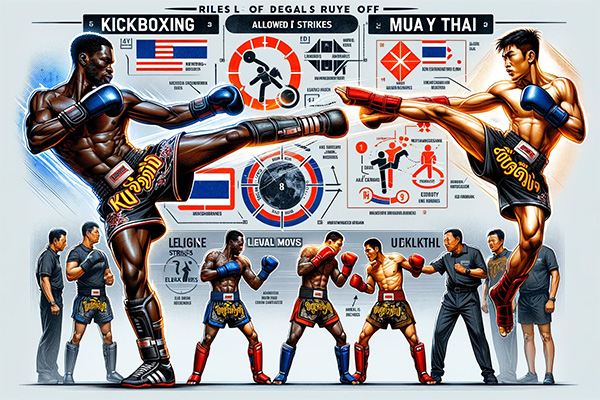

You see this mix-up all the time in American gyms. A class gets labeled “kickboxing,” someone else calls it Muay Thai, and from the outside the rounds can look close enough to pass for the same thing. Punches. Kicks. Pads cracking. Sweaty people trying to breathe between combinations. But once rules enter the picture, the similarity starts to fall apart.
That matters more than most beginners expect. Rules decide what happens when you grab the clinch, what lands legally, what judges reward, and even how a fighter carries a stance. In practice, the sport is the rule set. Change the rules, and the whole style shifts with it.
For U.S. fighters, that difference shows up everywhere: local smokers, sanctioned amateur events, MMA gyms, boutique fitness studios, even what gets taught on a random Tuesday night class. Some gyms teach a boxing-heavy kickboxing style with quick resets and no elbows. Others teach traditional Muay Thai with knees in close, longer clinch work, and scoring that values control more than sheer output.
Key Takeaways
- Muay Thai allows elbows, full knee attacks, and extended clinching.
- American kickboxing usually limits clinching and commonly bans elbows, especially in amateur settings.
- Muay Thai scoring values balance, visible effect, and control.
- Kickboxing scoring often leans toward volume, combinations, and forward pressure.
- Equipment rules and pacing vary by promotion and state oversight.
- Your best choice depends on whether your goal is fitness, striking competition, or MMA crossover.
What Is Kickboxing in the U.S.?
In the United States, “kickboxing” can mean a few different things, and that’s part of the confusion. Sometimes it means American-style kickboxing, the older format influenced heavily by boxing. Sometimes it refers to K-1 style rules, which allow more leg kicks and knees but still keep clinching on a short leash. And sometimes, honestly, it means a cardio class with music and zero chance of being hit back.
In competitive U.S. settings, kickboxing usually includes:
- Punches
- Kicks
- Limited knees in many modern formats
- Very short clinch exchanges
- No elbows in most amateur rule sets
That boxing influence is a big deal. You can feel it in the way kickboxers move. More combinations with the hands. More exits and angles. More rhythm changes off the jab. The sport tends to reward fighters who can put strikes together cleanly and keep the pace looking busy.
What kickboxing feels like in American gyms
A lot of U.S. gyms package kickboxing in a way that fits broad demand. That means conditioning, heavy bag rounds, mitt work, and classes that serve both hobbyists and aspiring amateurs. UFC Gym, title-style fitness studios, and MMA academies all use the word, but they do not always mean the same thing.
A familiar pattern shows up pretty fast:
- Boxing combinations come first
- Kicks are layered in after the hands
- Clinch time stays brief
- Sparring often moves at a quicker, more separated rhythm
That doesn’t make kickboxing less complete. It just makes it different. In a lot of American rooms, kickboxing is built for movement, pace, and clean exchanges rather than prolonged close-range control.
What Is Muay Thai?
Muay Thai is Thailand’s national sport, and its rule structure creates a very different kind of striking match. It’s often called the “Art of Eight Limbs” because it uses fists, elbows, knees, and shins. That phrase gets repeated a lot, sure, but the real difference shows up in what happens once fighters get chest-to-chest and the referee doesn’t jump in right away.
Traditional Muay Thai generally includes:
- Five rounds of 3 minutes
- Legal elbows
- Full knees
- Extended clinching
- Sweeps and off-balancing techniques that score
In the U.S., authentic Muay Thai gyms tend to preserve those core ideas, even when local amateur rules add protective gear or slightly modified safety measures. Cities with strong Muay Thai communities, like Las Vegas, Los Angeles, and New York, often produce fighters who understand not just the strikes, but the pacing and scoring logic behind them.
And that logic is different. A Muay Thai fight is not always about who throws more. Sometimes it’s about who controls more, lands cleaner, stays balanced, and makes the other fighter look unstable. That part throws off plenty of American viewers at first.
Elbows: The Clearest Rule Split
If one rule difference changes the entire feel of a fight, this is the one.
Kickboxing rules on elbows
In American kickboxing, elbows are usually banned. That single restriction shifts distance, guard habits, and risk. Fighters can stand a little more comfortably in close without worrying about a slicing elbow opening a cut.
Kickboxing without elbows tends to produce:
- Cleaner boxing exchanges at mid-range
- Fewer sudden fight-changing cuts
- Less danger in tight tie-ups
- More emphasis on punches and kicks as scoring tools
Muay Thai rules on elbows
Muay Thai allows elbows, and not just one basic version. Horizontal elbows, upward elbows, spinning elbows, downward elbows, sneaky short elbows in the clinch. They all matter. They score, they damage, and they can end a fight in seconds through cuts even when the overall strike count is close.
That’s why Muay Thai fighters often carry themselves differently in close range. The posture tightens. Head position matters more. Entries and exits get sharper because staying lazy in the pocket can get expensive fast.
From a U.S. viewer’s perspective, this is usually the first moment where the sports stop looking like cousins and start looking like separate languages.
Clinch Rules: Quick Reset vs. Real Control
Here’s where the rhythm really changes.
Kickboxing clinch rules
In most kickboxing formats, the clinch is temporary. A referee breaks it quickly, often after one action or a brief pause. Some rules allow one or two knees before separation. Others barely allow any sustained control at all.
That creates a fight with more resets. More open space. More clean visual exchanges.
Muay Thai clinch rules
In Muay Thai, the clinch is not a stall position. It is offense. It is control. It is scoring. Fighters can lock up, turn each other, land repeated knees, break posture, and off-balance an opponent in ways that judges notice immediately.
That means the clinch is trained like a full skill set, not an interruption.
Personal-style insight from a gym-floor viewpoint
- In kickboxing rounds, you usually see separation happen before any long inside battle develops.
- In Muay Thai rounds, the inside battle often is the story.
- Kickboxing rewards the fighter who can re-enter clean after a break.
- Muay Thai rewards the fighter who never gives that break away in the first place.
For U.S. athletes moving toward MMA, Muay Thai clinch work often carries over more naturally. Not perfectly, no. MMA changes posture and takedown threats. But the comfort level in close quarters tends to translate better than people expect.
Scoring Differences Shape Fighting Style
A lot of frustration around judging comes from watching one sport with the other sport’s expectations.
How kickboxing is commonly scored
In many U.S. kickboxing promotions, judges look closely at:
- Strike volume
- Clean combinations
- Aggression
- Ring control
- Visible activity
That favors fighters who stay busy and look commanding. A strong three-punch combination into a kick often reads well. Forward pressure helps. So does making the opponent retreat.
How Muay Thai is commonly scored
Muay Thai judging focuses more on:
- Effective strikes
- Balance after landing or absorbing
- Control in the clinch
- Knees and elbows with visible impact
- Overall dominance, not just busyness
A fighter can throw less and still look more convincing under Muay Thai scoring. That’s the part casual American viewers often find odd at first. One athlete may look flashier. The other may look calmer, more balanced, more in command. Under Muay Thai criteria, that calm control frequently carries more weight.
Legal Strikes Comparison
The easiest way to see the rule gap is on paper. The harder part is noticing how much that paper changes the fight.
| Technique | Kickboxing (U.S.) | Muay Thai | Commentary on the Difference |
|---|---|---|---|
| Punches | Yes | Yes | Both sports use boxing, but kickboxing often builds more combinations around hand volume. |
| Kicks | Yes | Yes | Both allow kicks, though Muay Thai tends to place heavier tactical value on body and leg kicks that visibly affect balance. |
| Knees | Limited in many formats | Yes | This changes close-range offense a lot. In Muay Thai, knees are a central weapon, not an occasional add-on. |
| Elbows | Usually no | Yes | This is the sharpest divide. Elbows alter distance, defense, and cut risk immediately. |
| Sweeps | Limited | Yes | Muay Thai rewards disruption of posture and balance more clearly. |
| Prolonged clinch | No | Yes | Kickboxing breaks the tie-up. Muay Thai lets the tie-up become the fight. |
That table looks tidy, maybe too tidy, but real fights feel messier. A small rule change on paper can completely shift how brave or cautious a fighter becomes in certain positions.
Protective Gear and Safety Rules in the U.S.
In the United States, sanctioning bodies and state athletic oversight shape amateur rule sets in practical ways. That means you may see variations depending on the event, the state, and whether the bout is a smoker, a novice match, or a fully sanctioned amateur contest.
Common U.S. safety measures include:
- Headgear in many amateur divisions
- Shin guards in beginner events and smokers
- Elbow pads in some Muay Thai competitions
- Modified clinch allowances for less experienced fighters
Nevada and California, for example, are known for more structured combat-sports oversight in licensed venues. Other states may have smaller local promotions with narrower interpretations of the rules. So, yeah, “kickboxing” on one flyer may not match “kickboxing” somewhere else.
That’s why checking the exact rule set before competing matters more than the gym label on the door.
Training Differences in American Gyms
Rules don’t just decide what happens on fight night. They decide what gets drilled every week.
Kickboxing training focus
In many U.S. programs, kickboxing classes emphasize:
- Boxing combinations
- Pad work
- Speed and rhythm drills
- Cardio-heavy rounds
- Fast entries and exits
This format works well for general fitness too, which is one reason kickboxing classes are everywhere in suburbs and commercial gyms. During New Year signup season or right before summer, these classes fill up fast because the structure is approachable and intense.
Muay Thai training focus
Muay Thai classes usually spend more time on:
- Clinch fighting
- Knee mechanics
- Elbow entries
- Posture and balance
- Checking kicks and returning cleanly
The posture alone can feel different. More upright. More patient. Less frantic. For competitors, that patience is not passive. It’s tactical.
A few observations that tend to hold up
- Kickboxing training often feels more combination-driven from day one.
- Muay Thai training often feels more positional once fighters get past the beginner stage.
- Kickboxing classes attract a bigger fitness crowd in the U.S.
- Muay Thai classes usually attract more people who want to spar, compete, or cross into MMA striking.
Which One Fits Your Goal?
This is where the question gets practical.
If your main goal is fitness and weight loss, kickboxing is usually easier to find and easier to stick with. Class times are broader, the learning curve is often gentler, and the workout format fits commercial gym schedules well.
If your goal is MMA preparation, Muay Thai gives you more useful experience in clinch work, knees, and elbow awareness. Not every piece transfers directly, but more of the close-range language carries over.
If your goal is amateur competition, the rule set in your state matters more than the style name on the website. Some gyms advertise Muay Thai but prepare athletes for modified amateur rules. Others market kickboxing but run K-1 style sparring. You have to look under the hood a bit.
Monthly training costs in the U.S. commonly fall between $120 and $250, depending on location, coaching reputation, and whether the gym sits in a major fight market.
FAQs
Is Muay Thai harder than kickboxing?
Muay Thai usually feels more demanding in close range because elbows, clinch fighting, and sustained knees add layers that many beginners don’t expect. Kickboxing can still be extremely technical and physically hard, just in a different rhythm.
Can kickboxers use elbows?
In most American kickboxing formats, no. Elbows are commonly prohibited, especially in amateur competition.
Does Muay Thai scoring reward damage more than volume?
Usually, yes. Effective strikes, balance, control, and visible impact matter more than simply throwing more shots.
Which style works better for MMA?
Muay Thai often offers better clinch tools and elbow familiarity. Kickboxing still helps a lot with boxing combinations, footwork, and distance striking.
Are kickboxing classes at fitness gyms the same as fight-team kickboxing?
Not usually. Fitness kickboxing is often built around conditioning, bag work, and calorie burn. Fight-team kickboxing is structured around sparring, timing, defense, and competitive rules.
Conclusion
Kickboxing and Muay Thai share enough surface-level traits to confuse a lot of people in the U.S. market. Both involve punches and kicks. Both build conditioning. Both can be taught in the same building. But the rules split them apart in ways that change everything else.
Kickboxing usually moves toward hand combinations, quick breaks, and scoring built around activity and ring control. Muay Thai leans into elbows, clinch fighting, knees, balance, and composure under pressure. One isn’t automatically better. The better fit depends on what happens in your gym, under your state’s rules, and inside your own goals.
Once you understand the rules, the styles stop blending together. The fight starts making sense.