
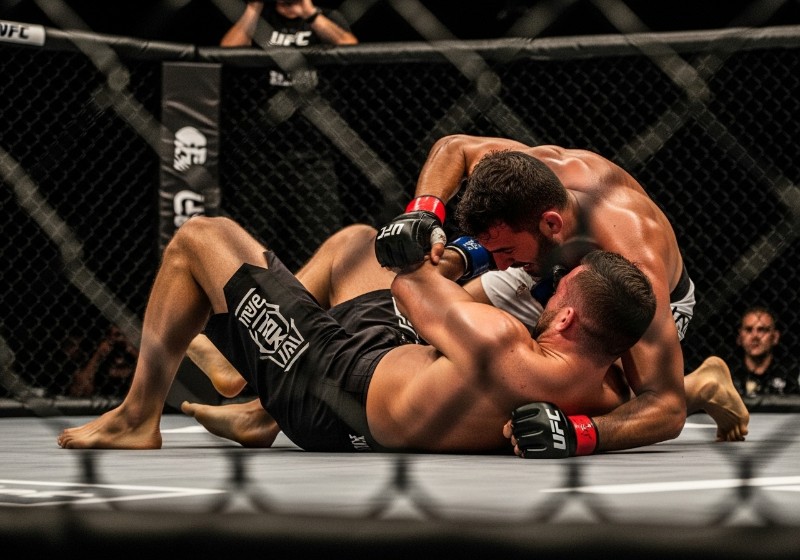

Most fans remember the knockout that ends a fight from the outside. The straight right hand, the jab-cross combo, the wide hook that lands flush and sends someone crashing to the canvas. That’s the highlight reel version of combat sports. But a huge number of fights — at every level, in every era — get decided when the distance collapses entirely. When two fighters are chest-to-chest, foreheads pressed together, and there’s nowhere to go.
That’s infighting. And it’s one of the most underappreciated, technically demanding skills in all of combat sports.
What Is Infighting in Boxing and MMA?
Infighting is close-range combat — fighting in the pocket, where punches are short and angles are tight and whoever controls position usually controls the fight. It’s not just two guys grabbing each other and hoping for the best. Done right, it’s a calculated, methodical way to dismantle an opponent who’d otherwise pick you apart from the outside.
In boxing, infighting means working the body with hooks and uppercuts, using shoulder pressure to disrupt rhythm, and staying in a position where your opponent can’t load up and hurt you. In MMA, the range of tools expands dramatically.
Boxing vs MMA Infighting
Here’s a comparison worth sitting with:
| Element | Boxing | MMA |
|---|---|---|
| Primary weapons | Hooks, uppercuts, body shots | Elbows, knees, short punches, clinch strikes |
| Control tools | Shoulder pressure, framing, hand fighting | Underhooks, overhooks, collar ties, cage work |
| Escape rules | Must break cleanly or referee intervenes | More latitude to work before separation |
| Takedown threat | None | Constant — changes how you position everything |
| Head placement | Critical for defense and leverage | Same, but also affects takedown defense |
The honest difference? In MMA, everything is more dangerous and more complicated. A fighter like Floyd Mayweather Jr. could use his shoulder and forearm to frame opponents and create distance — elegant, low-risk, nearly surgical. In the Octagon, that same moment of framing could get you taken down and put on your back. The takedown threat changes the geometry of infighting completely, and that’s what makes MMA clinch fighting its own discipline, not just “boxing but closer.”
Mike Tyson didn’t work in both worlds, but his boxing infighting was a template that MMA coaches have studied for decades. The way he collapsed distance, slipped under punches, and loaded up short hooks from the inside is still as relevant now as it was in the late 1980s.
Why Infighting Wins Fights
There’s a practical reason shorter fighters — and fighters with reach disadvantages — gravitate toward inside fighting. When you’re standing at range against someone with four extra inches of arm length, you’re essentially playing their game on their terms. They can land, you can’t. The math doesn’t work in your favor.
Collapsing distance changes that math.
Joe Frazier couldn’t outbox Muhammad Ali at distance. So he didn’t try. He pressured constantly, took punishment to get inside, and once he was there, Ali couldn’t generate power and couldn’t use that reach. Frazier made it a brawl at a range where his stocky build and shorter punches were assets, not liabilities. That’s pressure fighting strategy in its most distilled form.
Canelo Alvarez does something similar, though with more technical elegance. He uses head movement to get inside cleanly, then works the body and short hooks before the opponent can reset. He rarely looks rushed. He looks inevitable.
The key insight is this: reach advantages evaporate at close range. And once that advantage disappears, the fighter with better inside technique usually takes over.
Essential Infighting Techniques
Position Before Punches
Here’s where most fighters get it wrong. They get inside and immediately start throwing. But throwing without position is just burning energy and praying. What tends to happen when you do that is you expose yourself to underhooks, you lose your base, and suddenly you’re off-balance and getting countered.
Position first. Always.
Cus D’Amato built Mike Tyson’s entire game around this idea. Head position — specifically, getting your head to the outside of your opponent’s shoulder — creates a leverage advantage that makes your short punches significantly more damaging. Weight distribution matters too. Slightly bent knees, weight centered, hips engaged. That’s the foundation everything else is built on.
Underhooks give you control. Once you have an underhook, you control that side of your opponent’s body. You can turn them, rotate them, off-balance them. That’s not just defensive value — that’s positional dominance that creates punching opportunities.
Short Punch Mechanics
Short punches are their own technical category. They don’t work the same way as punches thrown from distance, and trying to generate power the same way is a recipe for weak shots.
The uppercut is the inside fighter’s best friend. It travels a short distance, goes right up the centerline, and lands on the chin or body with significant force when thrown correctly. Hip rotation drives it. Not arm strength — hip rotation.
Short hooks work similarly. The arm stays tight, the elbow doesn’t fly out, and the power comes from a compact rotation of the torso. What you’re generating is torque from a small movement, not momentum from a wide swing. It takes drilling. It doesn’t come naturally to most people.
The Role of the Clinch in MMA and Boxing
Offensive Clinch Control
Randy Couture turned the clinch into an art form. He wasn’t the most naturally gifted striker or wrestler in the UFC, but his clinch control was so methodical and exhausting that opponents would spend entire fights just trying to manage it. He’d get collar ties, drive into the cage, land short punches, and control the pace of every exchange. That’s what offensive clinch control actually looks like at its best.
Georges St-Pierre used his wrestling base to make clinch positions threaten in multiple directions at once. If you focused on defending his dirty boxing, the takedown was right there. If you worried about the takedown, the short punches came. That simultaneous threat is the highest level of inside fighting — when your opponent doesn’t know which problem to solve first.
Muay Thai adds a dimension boxing and wrestling don’t have: the knee from the clinch. A fighter with strong Thai clinch can drag you into a position and start landing knees to the body and head with serious force. It’s why MMA fighters who come from Muay Thai backgrounds often have strong inside games.
Dirty Boxing: The Hidden Weapon of Elite Fighters
How Dirty Boxing Creates Openings
Dirty boxing is essentially the combination of clinch control and short-range punching — using frames, grips, and positional manipulation to create high-percentage striking opportunities. It’s not exactly sanctioned in boxing (referees break it up), but in MMA, it’s a core skill.
Daniel Cormier was one of the best at this. He’d get an underhook, use his forearm to create separation on one side, and put his punch right through the opening he’d just made. It wasn’t flashy. It was methodical and devastating. His forearm pressure would tilt an opponent’s posture, expose the chin, and then the hook would land clean.
The frame control part of dirty boxing is often invisible to casual viewers. But it’s what creates the punching lane. Without the frame, the punch has nowhere clean to travel. With it, the opponent is already off-balance when the shot lands.
Common Infighting Mistakes That Cost Fights
Fighting Without Position
The single most common mistake at every level below elite is committing to punches before securing position. You see it constantly in amateur boxing and in early MMA careers — a fighter gets inside, gets excited, and starts unloading. Then they eat a counter because their head was in a predictable spot, or they get taken down because they were too squared up.
Overextension is the other big one. Reaching for punches when you’re not quite close enough, rather than closing the distance properly first. What tends to happen is the punch lands without power, and the fighter’s posture is compromised during it.
Poor defensive posture at close range is something coaches spend enormous time correcting. Upright posture inside is dangerous. You want a slight lean, head positioned outside the opponent’s shoulder, and your chin protected by your shoulder and arms. Standing straight up at close range is roughly the same as asking to get hit.
Training Methods to Improve Infighting Skills
Sparring and Positional Drills
The wall drill is underrated. Back your partner against the ropes or cage, take a close position, and practice controlling and striking without being able to use footwork as a crutch. It forces you to solve the inside game with technique rather than movement.
Hand-fighting drills — where both fighters are working for underhooks and wrist control without striking — build the instincts for inside positioning faster than almost anything else. It’s uncomfortable and awkward at first. That’s the point.
Dedicated clinch rounds in sparring, where fighters start every exchange at contact range, accelerate the development curve significantly. Most gyms spend the majority of sparring time in mid-range. But the inside game requires specific reps at close range to build the spatial awareness and reaction time the position demands.
Lessons From the Greatest Infighters in Combat Sports History
Boxing Legends
Tyson is the obvious starting point — his peek-a-boo style, developed under D’Amato, was specifically designed to get inside safely and then do damage with short, powerful hooks and uppercuts. Roberto Duran was another level of ferocity, with relentless pressure and body attack that broke opponents down over rounds. Bernard Hopkins used inside control more defensively, making himself almost impossible to hit clean by controlling position and limiting his opponents’ offense.
Canelo sits comfortably alongside those names now. His inside game has grown significantly as his career has progressed.
MMA Masters
Khabib Nurmagomedov’s inside game existed primarily to drag fights to the ground, but his clinch control was elite even standing. Jon Jones uses his unusual frame and long arms to control inside positions in ways opponents genuinely can’t replicate. Couture and Cormier were already covered — but both represent something important: high-level wrestling translates directly into high-level inside control in MMA.
How Modern Combat Sports Are Changing Infighting
Modern training has made inside fighting more sophisticated than it’s ever been. Fighters today have access to wrestling coaches, Muay Thai specialists, boxing trainers, and sports scientists all working together. The UFC Performance Institute has turned data analytics into part of the training equation — studying tendencies, identifying openings, and designing game plans around positional control rather than just power.
Hybrid striking is the product of all that cross-pollination. Fighters who understand the underhook from wrestling, the clinch from Muay Thai, and the short punch mechanics from boxing are simply more complete inside than someone who’s only trained one discipline.
Winning When Space Disappears
The universal principle underneath all of this is consistent: position creates leverage, leverage creates power, and power at close range wins exchanges. Timing matters. Balance matters. Knowing where your head is and where your opponent’s head is matters.
Infighting isn’t chaos. It feels chaotic from the outside, which is part of why casual fans underestimate it. But what you’re actually watching — when you know what to look for — is a technical battle for positioning, control, and leverage being fought in a space roughly the size of a phone booth.
That’s where a lot of fights are actually decided. Not at the end of a wide right hand from the outside, but in the inches between two fighters when distance collapses and only technique survives.