
How to Find the Right Boxing Stance for You
You ever watch someone shadowbox and know—just know—they’ve never taken a punch? That stiff, square stance… arms flapping like they’re trying to swat flies. Yeah, I’ve been there too. We all start somewhere, but if there’s one thing I wish someone drilled into me early on, it’s this: your boxing stance isn’t just how you stand—it is your foundation. Everything—your jab, your pivot, your defense, even how you breathe under pressure—flows from how you plant your feet and align your frame.
Now, the “best boxing stance” isn’t a one-size-fits-all deal. What works for a 6’2” rangy southpaw chasing points won’t suit a 5’8” pressure fighter built like a fire hydrant. Your body mechanics, center of gravity, even whether you’re left- or right-handed—these things matter. They decide where your balance lives, how your weight shifts, how much power you can generate without falling over yourself.
What I’ve found is, when beginners try to copy pro stances without understanding their own physical blueprint, their whole game crumbles. Fast. That’s why getting your foot positioning and defensive posture dialed in from day one is non-negotiable.
So, before you throw another sloppy jab, let’s figure out how to find your boxing stance—the one that actually fits you.
Why Your Boxing Stance Matters More Than You Think
You can have fast hands, sharp eyes, and all the cardio in the world—but if your stance is off, everything else crumbles. I’ve seen it time and time again. Guys trying to load power from their arms instead of their feet, or throwing combos with their hips frozen stiff. You feel fast, until you’re flat on your ass wondering what just hit you.
Your stance isn’t just a pose—it’s the anchor for your kinetic chain, the engine behind your hip rotation, and the blueprint for your defensive posture. When your weight distribution is right, your punches land cleaner, your movement flows smoother, and your body stays aligned around the centerline. That’s where your balance lives. That’s how you stay dangerous without losing control.
Now, I’ve made the mistake of ignoring stance width early on. Thought I could “figure it out later.” Bad call. Led to sore knees, sloppy pivots, and a sprained ankle that benched me for a month. So yeah—learning the fundamentals saves you pain, literally.
What I’ve found is this: when you dial in your stance, your whole game levels up—power, speed, control, even confidence. It’s not sexy, but it’s the foundation. Start there.
Types of Boxing Stances Explained
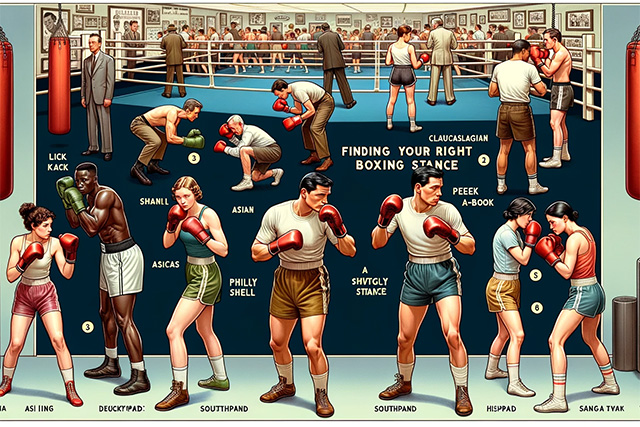
The stance you choose in boxing—orthodox, southpaw, squared, or something more stylized like the Philly shell—sets the tone for how you fight, how you move, and honestly, how you survive in the ring. I can’t tell you how many times I’ve seen beginners default to whatever they saw their favorite fighter use, without understanding the “why” behind it. (Spoiler: copying Mayweather’s shoulder roll with zero head movement is a bad life choice.)
If you’re right-handed, you’ll likely start in the orthodox stance—left foot forward, left jab hand out front, right hand locked and loaded. Southpaws? Same thing, just mirrored. And believe me, that mirror matters. Fighting southpaw vs orthodox completely changes how you line up your lead foot, your rear hand, and even how you cover your centerline.
The Philly shell—that slick, shoulder-rolling posture—is all about rhythm and counterpunching, but it demands serious timing and hip control. Then there’s the peek-a-boo—tight guard, rapid head movement, centerline pressure. Feels like a bulldozer when done right.
What I’ve learned? There’s no single “best” stance. Each has trade-offs—offense vs defense, mobility vs stability. You’ve gotta test them, feel them out. Your chin tuck, guard position, even how naturally you pivot—all of it tells you what fits.
How to Figure Out Your Dominant Side (And Why It Actually Matters)
You’d be surprised how many people train in the wrong stance for months—sometimes years—just because they think they’re right-handed. I’ve seen it in gyms, I’ve done it myself. You assume dominant hand = rear hand, and boom, you’re in orthodox without a second thought. But here’s the thing: dominance in boxing isn’t just about which hand you write with—it’s about how your body moves under pressure.
Try this: clap your hands, like naturally, without thinking about it. Notice which hand’s on top? That’s usually your dominant motor side. Or stand tall and have someone give you a gentle push from behind—whichever foot you step forward with first tends to be your lead side. (Weird how your body gives away your secrets, right?)
What I’ve found is that reaction time, coordination, and balance—all rooted in brain lateralization—tend to favor one side more subtly than most folks notice. I used to think my right hand being stronger meant I had to keep it in the back for power. But when I switched to southpaw and started jabbing with my dominant hand, everything snapped into place—my timing, my angles, even my confidence.
So don’t just default to orthodox or southpaw. Do a few stance tests at home, play around on the bag, shadowbox both ways. You’ll feel it when it’s right. Trust your body—it knows stuff your brain hasn’t caught up to yet.
Matching Your Body Type to the Right Stance
You ever watch Deontay Wilder throw that missile of a right hand and think, How does he even stay balanced up there? That dude’s got levers for limbs. Super tall, long reach, narrow frame—classic high-center-of-gravity fighter. Now compare that to Mike Tyson in his prime—short, thick legs, wide base, low center of gravity. Two totally different bodies, two totally different stances.
What I’ve learned over the years is your stance has to match how your body moves, not just how you think it should look. If you’re tall with long arms and legs, a more upright, long reach stance gives you space to launch that jab and work from range. Think outside foot control, rangy one-twos, lots of lateral movement. But if you’re shorter, especially with strong legs and a stockier build, you’ll want a compact stance—tight guard, head movement, and close-range explosions. That’s where a low center stance helps you slip and rip inside, just like Tyson did.
I used to try fighting tall even though I’m built like a damn fire hydrant. Didn’t work. Once I squared up, dropped my level, and used my legs, I stopped getting tagged so much. So yeah—don’t fight your frame. Build your stance around it.
Choosing the Right Stance for Your Boxing Goals
First thing I ask people when they walk into the gym isn’t “orthodox or southpaw?”—it’s “what are you here for?” Because your stance should match your purpose, not just your hand. You’d be shocked how many folks at places like TITLE Boxing or LA Boxing just jump into a default stance without thinking about why they’re training.
Here’s what I’ve learned from coaching all kinds of boxers (and plenty of not-boxers too):
- For fitness/cardio boxing
You’ll want a mobility stance—nothing too tight or squared up. Keep your feet light, bounce a little, and focus on flow over form. You’re chasing heart rate, not knockouts. - For self-defense
Prioritize a defensive stance—hands higher, elbows in, feet stable. You’re not trying to win rounds, you’re trying to not get dropped in a parking lot. Balance and quick exits matter more than foot feints. - For amateur competition
You’ll need a ring control stance. I’ve seen this a lot in Golden Gloves circles—think clean footwork, high-volume jab, and enough spring in your step to rack up points without trading too much. - For pro-level or MMA crossover
Go deeper—choose between aggressive or counter-punching stances based on your style. Pro training demands a layered stance strategy: how you set traps, control distance, shift weight… it’s chess, not checkers.
Drills to Test and Improve Your Boxing Stance
One thing I always tell beginners is this: your stance isn’t proven until it moves. It might look sharp in the mirror, but once you start stepping, pivoting, throwing—that’s when the truth shows up. I’ve had days where I looked slick standing still, but the moment I threw a jab and slid left? Boom—feet crossed, balance gone. Humbling.
Here are a few simple drills I use (and still go back to) when I feel off or stiff:
- Mirror Shadowboxing (1–2 minutes rounds)
Watch your feet, not just your hands. Are your knees soft? Are you lifting your heels too much? This one exposes weird habits you don’t feel but can see. - Jab + Slide Drill
Throw a jab, then slide a few inches left or right. You should stay in stance—no jumping, no crossing feet. What you’re testing is how cleanly your foot slide supports your punch. - Pivot + Reset Drill
Pick a spot on the floor. Throw a combo, pivot 90° around that spot, and return to stance. If your stance collapses after turning, it needs tightening. - Range Finder Test
Jab the air and check: are you leaning forward? If yes, you’re out of range. Adjust your stance length instead of overreaching.
Common Stance Mistakes to Watch Out For (and Fix Early)
I’ll be honest—when I first started out, I thought having a “good stance” just meant standing there looking cool. Shoulders up, gloves up, chin down… y’know, textbook. But once I started sparring, that picture-perfect pose collapsed the second I had to move or react. What I’ve found since is, most beginners make the same handful of stance mistakes—and they’re fixable if you catch them early.
Here’s a breakdown of common issues I see all the time in U.S. gyms (and yep, I’ve been guilty of a few myself):
- Flat-footed stance
You’re not rooted—you’re stuck. If your heels are glued to the mat, you lose mobility and get lit up. Stay light. Bounce a little. Be ready to shift. - Too wide or too narrow
A wide base kills your ability to pivot. Too narrow? You’ll tip over when you throw. Find that shoulder-width sweet spot. Trust me—it matters more than you think. - Overreaching on punches
This one’s sneaky. If you’re leaning to land a jab, you’re out of range—and probably off-balance. I used to do this constantly and paid for it in counters. - Chin too high / hands too low
Classic overexposed guard mistake. You’ll get away with it on the bag, but not in sparring. Tuck your chin into your lead shoulder. Make it a habit. - Stiff legs, frozen posture
A stance isn’t a pose. It’s a launchpad. Keep your knees bent and posture loose—think “loaded spring,” not “statue.”
How to Evolve Your Boxing Stance as You Grow
When you’re starting out, your stance feels like a fixed thing—orthodox or southpaw, knees bent, chin tucked. Done. But over time, especially as you start sparring more or chasing different goals, that “fixed” stance starts to feel like a shirt that’s too small. You outgrow it. I’ve been there, and honestly, it’s one of the best parts of boxing—watching your stance evolve into something yours.
Here’s what I’ve learned about making that transition smoother:
- Let sparring feedback guide you. The bag won’t tell you much, but sparring will. If you’re getting countered too easily, it might be time to tweak your weight transfer or narrow your base.
- Experiment with hybrid stances. Look at Terence Crawford—he didn’t become elite by locking into one posture. Start with small drills switching lead hands mid-round or testing a more fluid stance.
- Match your stance to new goals. Training for fitness? Stay mobile. Going competitive? Tighten up for defense and angles.
- Refine, don’t reinvent overnight. I used to overhaul everything at once (bad idea). Make one change, test it for a week, then layer in the next adjustment.