
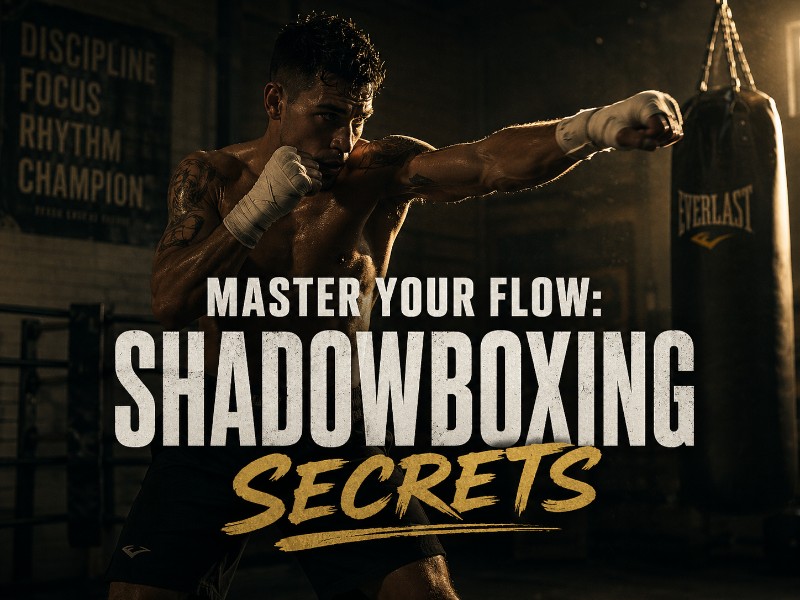

Most shadowboxing looks the same from the outside. Hands moving, feet bouncing, sweat showing up somewhere around round two. But there’s a version that feels different — almost unhurried, even when the pace picks up. That version has a quality to it that’s hard to name until you’ve felt it yourself.
That quality is flow.
Shadowboxing earns its place in training because it gives you a full striking rehearsal without needing a bag, pads, a partner, or even a ring. You’re building rhythm, balance, timing, defense, and decision-making all at once — in open space, on your own terms. In boxing gyms, MMA studios, garage setups, and boutique fitness studios across the United States, shadowboxing often shows up daily because it solves one honest problem: it lets you practice fighting movement when there’s nothing in front of you except room.
Modern fighters didn’t invent that idea, but certain people made it impossible to ignore. Muhammad Ali turned movement into something closer to conversation. Floyd Mayweather Jr. showed that relaxation, shoulder position, defensive rhythm, and tiny weight shifts could create control that looked almost passive. Different eras, wildly different styles — but the same underlying point: smooth movement tends to outlast forced movement.
What Is Flow in Shadowboxing?
Flow in shadowboxing means your punches, footwork, defense, breathing, and balance connect without obvious gaps or resets. It’s not about throwing combinations at a certain speed. It’s about moving in a way where each action already carries the shape of the next one inside it.
Rigid shadowboxing has a specific look: jab, pause, cross, reset, hook, freeze. Each punch feels isolated. The body restarts from scratch after each move, like it’s rebooting.
Fluid shadowboxing reads differently. The jab creates the opening for the cross. The cross shifts weight that makes the hook natural. The hook sets up a slip or a pivot. The feet stay active underneath all of it. Nothing feels stuck.
There are two sides worth understanding here.
The physical side covers balance, joint relaxation, foot placement, shoulder rhythm, and breathing patterns. The mental side covers visualization, timing, and the ability to let go of the combination checklist long enough to actually move. When both sides work together, the round stops feeling like a rehearsal and starts feeling like something closer to instinct.
For boxing, flow means punching without burning unnecessary movement. For MMA, it means blending strikes with angles, level changes, and defensive exits rather than treating each skill like a separate item on a list. For fitness classes, it’s what keeps intensity honest without turning rounds into stiff, mechanical arm-swinging.
A good sign that it’s working: you finish a round tired, but you don’t feel like you just fell down a flight of stairs.
Benefits of Improving Flow Through Shadowboxing
Better shadowboxing flow builds coordination, endurance, rhythm, reaction speed, and stress tolerance — and none of it requires equipment. That combination is genuinely unusual in fitness.
The benefits compound quickly because shadowboxing is brutally honest in a way that other tools aren’t. A heavy bag gives your fists something solid to land on, which means it can absorb and hide bad balance. Shadowboxing doesn’t offer that. If your cross drags your chest forward, there’s nothing there to prop you up — just open air and whatever the room shows you.
What tends to improve with consistent practice:
- Sharper coordination: Your hands, feet, hips, head, and eyes gradually start working as one connected system rather than separate body parts taking turns.
- Better rhythm: You stop moving at a single steady tempo and start using changes in pace as part of how you move.
- Cardio without equipment: A 3-minute round of active shadowboxing — where movement stays continuous — can feel surprisingly close to interval training.
- Improved muscle memory: Clean repeated patterns help your body find punches faster when fatigue sets in.
- Faster defensive reactions: Slips, rolls, pivots, and counters become easier to access when you actually practice them instead of just knowing they exist.
- Stress relief: Boxing-based fitness programs, including setups like TITLE Boxing Club, use shadowboxing specifically because controlled striking gives tension a useful outlet.
- Calorie burn: According to Harvard Health Publishing, a 155-pound person burns roughly 324 calories in 30 minutes of boxing-related activity, though intensity and body weight both affect the final number [1].
What’s useful about shadowboxing is that it scales honestly. A beginner can move lightly for 10 minutes and get something from it. A conditioned athlete can run 6 hard rounds with full footwork, defense, and explosive changes. Same practice. Very different demands.
Foundational Techniques for Better Flow
Flow starts with stance, posture, relaxation, breathing, and balance. The flashy stuff comes after — and usually later than people expect.
Your stance sets everything else up. In a boxing stance, your feet sit roughly shoulder-width apart, lead foot forward, rear heel slightly light, knees soft, chin tucked, elbows close enough to cover the ribs. In an MMA stance, your feet often spread a bit wider because kicks, takedowns, and sprawls change what you need to protect.
Posture gets overlooked, but it matters more than it probably should. A collapsed chest makes punches shorter and heavier. A rigid upright spine makes defense jerky and slow. The useful place to land is something like tall-but-loose — ready to move without trying to look athletic about it.
Relaxation is the part that trips people up. Newer boxers often default to looking powerful, so every movement comes out tight. The shoulders climb. The jaw locks. The hands come back slowly because the body is essentially fighting itself. It’s a hard habit to break because it feels like effort, which reads as progress, but it isn’t.
Breathing handles more of this than people expect. Short exhales on punches keep the torso engaged without making it rigid. Quiet breathing during footwork keeps the round from becoming panic cardio somewhere around the 90-second mark.
In practice, the small habits tend to matter most:
- Keep your punches light enough that they return fast.
- Let your feet move before your upper body reaches for the next punch.
- Exhale on strikes without forcing a loud sound every single time.
- Stay balanced after the last punch in a combination, not just the first.
- Leave some looseness in the shoulders between combinations, not just during them.
The body won’t flow when every punch gets thrown like a fight-ending shot. Shadowboxing tends to reward control more than aggression, which is an adjustment for a lot of people.
Footwork Drills to Enhance Fluid Movement
Fluid shadowboxing depends on feet that move early, quietly, and with some sense of direction. Punches get most of the attention in any boxing conversation, but the feet are what decide whether the combination has somewhere to actually go.
The step-and-slide drill is where most people start, and for good reason. Moving forward means stepping with the lead foot first, then sliding the rear foot to recover stance. Moving backward means stepping with the rear foot first. Left goes with the left foot first. Right with the right foot first. That sounds almost too simple — until fatigue sets in and people start crossing their feet, bouncing too high, or letting the stance compress into something that barely exists.
Pivoting adds another dimension. After a jab-cross, a small lead-foot pivot can move you off the center line entirely. That angle matters because imaginary opponents, even good ones, don’t politely stand still in front of you. Vasiliy Lomachenko became famous for using angles and footwork to force opponents into bad positions before they could set up a response — and that style makes it obvious why movement creates offense as much as it creates defense.
Lateral movement drills help break the habit of drifting straight backward. Move left for 3 steps, jab while moving, pivot out, reset. Move right, feint, cross, roll, exit. Keep it messy at first. Clean tends to show up later on its own.
A useful progression to think through:
| Drill | What It Builds | What Actually Happens |
|---|---|---|
| Step-and-slide | Base balance | Feels boring until bad balance starts collapsing combinations mid-round. |
| Pivot after cross | Angle creation | Makes shadowboxing feel less like punching a mirror, more like navigating space. |
| Lateral shuffle with jab | Moving offense | Reveals whether your jab only works when you’re standing still. |
| Defense-only movement | Control under pressure | Humbling, because there are no punches to distract from what your feet are actually doing. |
| Free movement without punches | Rhythm | Shows whether your body can flow before the hands start performing. |
For most people, practicing movement without punches is the missing piece. It feels too simple to bother with — which is probably why it gets skipped — but it builds the floor that everything else stands on.
Combining Punches Smoothly
Smooth punching means each strike returns, transfers weight, and sets up the next action. A combination isn’t really a list of punches. It’s more like a chain where each link shapes the next one.
The jab-cross-hook is a clear example. The jab creates distance and timing. The cross rotates the rear hip. The hook uses the return path and weight transfer the cross already created. When the body understands that sequence as a single thing, the combination feels compact and almost inevitable. When it doesn’t, the hook swings wide, the feet freeze, and the whole thing looks like three separate events that happened to occur in a row.
Overcommitting breaks flow faster than almost anything else. A hard cross that drags your head forward might look powerful, but it takes the next movement away from you. A hook thrown with too much shoulder tension delays your guard return. A wide uppercut lifts your posture and leaves you standing tall in a way that tends to make sparring partners happy.
Shadowboxing rounds work better when continuous motion stays more important than hitting perfect combinations. One round can focus on jab entries. Another on 3-punch exits. Another on mixing light touches with sudden bursts. The variety keeps the movement honest.
Some combinations worth working through:
- Jab, cross, lead hook, pivot out.
- Double jab, cross, slip right, cross.
- Jab to body, jab to head, rear uppercut.
- Cross, lead hook, roll under, lead hook again.
- Feint jab, step right, cross, hook, exit.
The invisible opponent matters here more than people realize. Punch at something that has height, distance, and imagined reactions. Punching the air like the air is simply there tends to produce shadowboxing that looks exactly like that.
Using Visualization to Improve Flow
Visualization improves shadowboxing because it gives every movement a reason. Without an imagined opponent, shadowboxing can drift into choreography — technically fine but mentally empty. With one, it becomes something closer to a rehearsal with stakes.
Picture an opponent stepping in after your jab. Slip outside. Counter with the cross. Picture that same opponent backing up after your hook. Step with them. Cut the angle. Picture pressure coming after your combination. Roll, pivot, reset the distance.
Elite athletes use mental rehearsal because the brain practices decision patterns even when the body isn’t taking contact. Research on motor imagery — specifically Driskell, Copper, and Moran’s work in the Journal of Applied Psychology — shows that mental practice improves performance when paired with physical practice, particularly for skills involving timing and sequencing [2].
Defense transitions are where visualization pays off most noticeably. Slips, rolls, pulls, blocks, and counters all need a trigger. Shadowboxing gives you that trigger when you imagine punches actually coming back at you.
A simple defensive flow round to try:
- Move for 20 seconds with only jabs and feints.
- Add slips after every second jab.
- Add a counter after each slip.
- Add a pivot after each counter.
- Reset the distance before starting the cycle again.
This builds fight IQ without sparring. It doesn’t replace sparring, and it doesn’t teach you how to manage contact — but it does make sparring considerably less mentally chaotic when that day arrives.
Rhythm and Timing: The Secret to Flow
Rhythm creates flow because real striking happens in shifting tempos, not consistent beats. A fighter who moves at one pace becomes readable. Predictable, really.
Tempo is the speed of your movement. Timing is when you choose to act. Shadowboxing lets you experiment with both. Move slowly for 5 seconds. Burst for 2 seconds. Pause half a beat. Feint. Step off the line. Punch again. The variation is the point.
Music can help, especially in fitness settings. Apps like Nike Training Club, boxing timers, and round trackers make it easier to structure training without watching a clock. A timer also removes the option to stop when a round gets uncomfortable — which is probably the most useful thing it does.
That said, music has a genuine downside. If every punch lands on the beat, your rhythm becomes predictable in a way that actually works against you in fight-oriented training. For that kind of shadowboxing, mixing fast and slow work matters. Breaking rhythm on purpose matters.
One useful structure for a 3-minute round:
| Time Block | Focus | Feel |
|---|---|---|
| 0:00–1:00 | Light movement, jabs, feints | Loose and exploratory |
| 1:00–2:00 | Combinations with defensive exits | More deliberate |
| 2:00–2:30 | Fast bursts | Messier, more demanding |
| 2:30–3:00 | Controlled recovery movement | Tired but still technical |
The last 30 seconds tends to be where form starts negotiating with fatigue. That negotiation is worth paying attention to.
Common Mistakes That Disrupt Flow
The biggest flow-killers are overthinking, stiffness, ignored footwork, uncontrolled speed, and inconsistent practice. Most people run into at least three of these regularly.
Overthinking shows up as hesitation. You start planning the perfect 6-punch combination while your feet stop moving and your mental opponent walks right through you. Better rounds often involve fewer punches and more reactions to what you’ve imagined.
Stiffness is common and subtle. Tense shoulders make punches slower and heavier. Locked hips make pivots clunky. A tight jaw somehow spreads tension to the rest of the body in a way that sounds strange until you notice it happening around the third round.
Ignoring footwork turns shadowboxing into upper-body cardio. The hands look busy, but the body stays parked. In actual boxing, a stationary target is an available target. In fitness boxing, stationary movement usually becomes repetitive stress on the same joints in the same positions.
Moving too fast without control is the tricky one because speed feels productive. But fast bad reps teach fast bad habits, and those habits tend to stick around longer than the speed does.
Common disruptions worth watching for:
- Throwing every punch at full power every time.
- Letting hands drift down after combinations.
- Crossing feet during lateral movement.
- Leaning toward a target instead of stepping.
- Holding your breath during bursts.
- Running the same combination for the entire round.
- Stopping completely after a mistake instead of continuing through it.
Consistency matters in a way that’s easy to underestimate. One excellent shadowboxing session doesn’t change much. Three short sessions a week for a few months changes how movement actually feels.
Shadowboxing Routines to Build Flow
Shadowboxing routines build flow fastest when each round has a clear purpose but leaves room for natural movement. Too much structure feels mechanical. Too little turns into wandering that doesn’t really go anywhere.
Beginner 10-Minute Flow Routine
A beginner routine works best when the pace stays light and the focus stays narrow. There’s no point in adding complexity before the basics feel like basics.
| Time | Work |
|---|---|
| 2 minutes | Stance, guard, light bouncing, step-and-slide |
| 2 minutes | Jab only with forward and backward movement |
| 2 minutes | Jab-cross with resets after each combination |
| 2 minutes | Jab-cross-hook with pivot exit |
| 2 minutes | Freestyle with light punches and relaxed breathing |
The goal isn’t exhaustion. The goal is noticing where your balance disappears and what causes it.
Intermediate Combination-Based Rounds
Intermediate rounds can use 3 rounds of 3 minutes with 60 seconds rest between each.
Round 1: Jab entries, double jabs, body-head changes.
Round 2: Jab-cross-hook, slip, counter, pivot.
Round 3: Freestyle with a required defensive exit after every combination.
The structure gives enough control to actually improve technique, but not so much that the round becomes a memorized sequence you’re just running through.
Advanced Freestyle Shadowboxing
Advanced freestyle shadowboxing usually looks less chaotic than people expect. There are feints, pauses, small defensive reactions, stance adjustments, and sudden attacks mixed in. There’s more quiet space inside it, not less.
An advanced 5-round structure:
| Round | Focus |
|---|---|
| 1 | Footwork and feints only |
| 2 | Long-range boxing |
| 3 | Inside defense, rolls, short counters |
| 4 | High-intensity intervals — 20 seconds fast, 20 seconds controlled |
| 5 | Freestyle with full visualization |
This resembles High-Intensity Interval Training when the bursts get demanding. The American College of Sports Medicine describes HIIT as repeated high-intensity efforts alternated with recovery periods — which fits a lot of boxing conditioning formats fairly well [3].
Tools and Gear That Can Help
Shadowboxing needs nothing. But mirrors, timers, light hand weights, and fitness trackers can make the practice easier to measure and correct.
Mirrors help with self-correction. They show dropped hands, uneven shoulders, lazy pivots, and stance narrowing over time. The risk is staring too much. Real opponents don’t live inside mirrors, so mirror rounds work best as occasional technical checks rather than a permanent habit.
Timer apps and round trackers keep training honest in a low-key way. Three minutes feels different when a clock isn’t willing to stop because you’re tired.
Light hand weights are genuinely controversial. One- or 2-pound weights can build shoulder endurance when used carefully, but heavier weights alter punch mechanics and create joint stress that tends to accumulate. For most people, short controlled rounds produce more usable results than trying to turn punching into dumbbell work.
Smart fitness devices — Apple Watch and similar trackers — can monitor duration, heart rate zones, and rough calorie estimates. The numbers aren’t precise, but they reveal patterns worth knowing. A round that felt easy might show a significant heart rate spike. A round that felt intense might show more standing around than you thought.
Useful tools:
- Mirror for posture and guard checks.
- Boxing timer app for 2- or 3-minute rounds.
- Phone camera for reviewing footwork afterward.
- Light hand weights for cautious endurance work.
- Apple Watch or similar tracker for heart rate patterns.
The camera is often the most useful tool in that list. It catches the things your body politely decides not to notice while it’s happening.
How Shadowboxing Fits Into a Full Training Program
Shadowboxing fits into a training program as a warm-up, a skill block, a conditioning tool, a cooldown, or a low-intensity movement session on recovery days. It adapts to whatever role needs filling.
Before heavy bag work, shadowboxing prepares the shoulders, hips, ankles, and nervous system. It lets you rehearse the combinations before impact enters the equation. That usually makes bag rounds cleaner and more intentional.
Before mitt work, shadowboxing sharpens rhythm and distance awareness. Mitts require reaction and accuracy, so a few rounds of looseness first tends to help the body arrive ready rather than catching up mid-session.
After hard training, light shadowboxing can serve as a cooldown. The movement stays technical, but the intensity drops significantly. That lets you finish the session with clean rhythm rather than ending on exhausted, falling-apart punches.
For MMA, shadowboxing can incorporate stance switches, sprawls, knees, elbows, kicks, and level-change feints. The same flow principle applies. Movement connects rather than arriving as a collection of separate techniques.
On recovery days, keeping it low-intensity — 10 to 20 minutes of light movement — maintains coordination without punishing the joints. That matters for older athletes, people with demanding schedules, and anyone trying to train consistently without feeling wrecked throughout the week.
Tracking Progress and Staying Consistent
Progress in shadowboxing becomes visible when you track rounds, duration, movement quality, and video feedback over time. Flow can feel vague, so tracking something concrete helps.
Measurable targets are more useful than general goals. Instead of “get smoother,” track something you can actually see: complete 4 rounds without crossing your feet. Add a defensive exit after every combination. Keep breathing controlled through a full 10-minute routine. Record one session per week and compare posture, balance, and pacing across a few weeks.
A simple weekly structure:
| Day | Session |
|---|---|
| Monday | 3 rounds technique-focused shadowboxing |
| Tuesday | Bag work or strength training |
| Wednesday | 10-minute light flow session |
| Thursday | Combination rounds with defense |
| Friday | Conditioning intervals |
| Saturday | Class, sparring, or longer skill session |
| Sunday | Rest or very light movement |
Joining a local boxing gym, MMA class, or fitness boxing studio adds accountability. It also brings outside correction, which matters because self-coached shadowboxing has a tendency to drift into comfortable habits that feel fine but don’t actually improve.
Video review adds another layer worth using. Watch for three things only: balance after punches, hand return, and foot position. Adding more than that tends to turn into a film study session that lasts longer than the workout did.
Closing Thoughts
Flow in shadowboxing gets built through repetition, attention, and cleaner movement under fatigue. It doesn’t arrive all at once — usually the first change is small. The feet stop tangling. The shoulders loosen. The jab comes back faster. The body stops needing a full reset after every combination.
Shadowboxing stays one of the most accessible tools in boxing because it strips everything down to movement quality. No bag. No pads. No partner. Nowhere for bad habits to hide.
The smoothest athletes make it look effortless, but that appearance is the result — not the starting point. Muhammad Ali’s glide, Floyd Mayweather Jr.’s defensive rhythm, Lomachenko’s angles, and the clean movement in good American boxing gyms all trace back to the same uncomfortable reality: flow gets practiced slowly, for a long time, before it ever looks fast.
A few mindful rounds each week can shift how you move. Not in a straight line, and not on any particular schedule. But after enough honest rounds, the body starts connecting the pieces without needing to think through each one first.
Sources
- Harvard Health Publishing, “Calories burned in 30 minutes for people of three different weights.”
- Driskell, Copper, and Moran, “Does Mental Practice Enhance Performance?” Journal of Applied Psychology.
- American College of Sports Medicine, High-Intensity Interval Training guidance.