
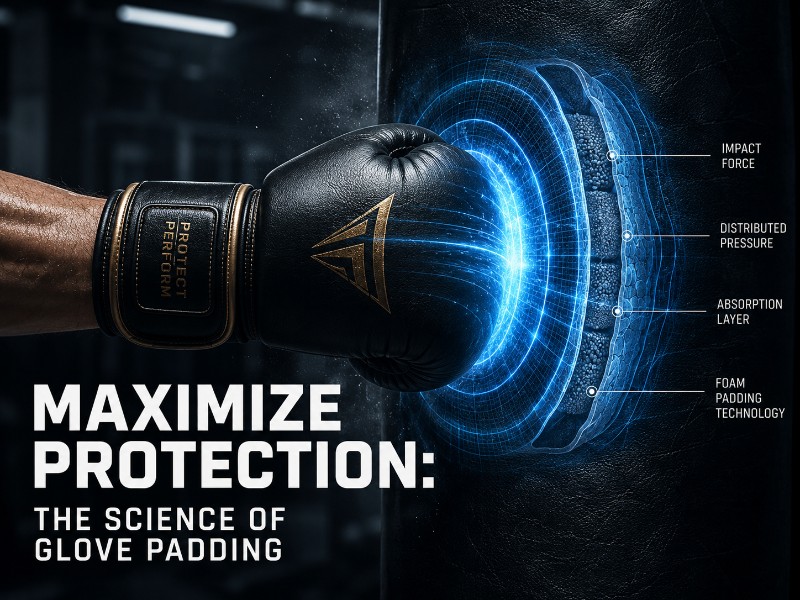

Every punch thrown in a gym — whether you’re a teenager at a USA Boxing affiliate in the Bronx or a fitness boxer working a heavy bag in your garage — passes through a few ounces of foam and leather before it connects. That layer of padding isn’t just cushioning. It’s physics, engineering, and injury prevention all compressed into a glove. And most people, even experienced fighters, don’t think much about how it actually works until something goes wrong.
This is worth understanding. Not just for safety reasons, but because knowing how impact distribution functions helps you pick better gear, train smarter, and recognize when a glove is doing its job — and when it isn’t.
The Physics Behind Every Punch
Here’s the simplest version: Force equals mass times acceleration. When your fist travels toward a target, it carries kinetic energy. At the moment of contact, that energy has to go somewhere.
Without padding, it transfers almost entirely into the point of contact — concentrated into a small surface area, delivered almost instantly. That’s what makes bare-knuckle impact so damaging. The pressure (force divided by area) is extremely high, and the deceleration is nearly instantaneous.
Padding changes all of that. It expands the effective surface area of the strike, which reduces peak pressure. More importantly, it extends the deceleration time. Instead of the fist stopping abruptly, the foam compresses across a fraction of a second — and that small window of time matters enormously. This is the impulse principle from Newton’s Laws of Motion: the same force spread over more time produces less peak impact force at any given moment.
Think of it like a car airbag. The physics are different in scale, but the principle is identical. Shock absorption isn’t about eliminating energy — it’s about managing how fast that energy arrives.
The American College of Sports Medicine has noted in its sports injury research that deceleration rate is one of the primary variables in blunt trauma severity. Boxing glove padding exists, fundamentally, to slow that rate down.
What Your Gloves Are Actually Made Of
Not all padding is the same, and the difference between a $50 entry-level glove and a $280 professional model isn’t just branding.
Layered foam is the most common construction. Multiple densities of foam are stacked — typically a softer outer layer to initiate compression, with firmer layers beneath to resist full collapse. Everlast and Ringside use variations of this in their mid-range lines. The goal is a progressive compression curve: soft on initial contact, firmer as force increases.
Injected mold foam uses a single piece of shaped foam rather than layered sheets. It’s cheaper to produce and common in beginner gloves. The problem is that it tends to compress uniformly, meaning it bottoms out more easily under repeated heavy strikes.
Gel padding systems — used by Hayabusa and some Winning models — integrate gel inserts near the knuckle zone. Gel distributes lateral force more evenly than foam alone, and it doesn’t compress as much over time. The tradeoff is cost and weight.
Horsehair padding, traditional in brands like Cleto Reyes, is favored by professional fighters for its firm, consistent feel. It disperses force differently than foam — it doesn’t compress as dramatically, which means it transfers more impact to the target. That’s intentional. For competition, especially, some fighters prefer a glove that punches “harder.” For sparring, it’s a different conversation.
Hybrid foam-gel combinations sit in the middle. Brands like Hayabusa’s T3 or the upper Everlast lines use these to balance protection with feel.
A Quick Comparison
| Padding Type | Protection Level | Power Transfer | Durability | Price Range |
|---|---|---|---|---|
| Layered foam | High | Moderate | Good | $60–$150 |
| Injected mold foam | Moderate | Moderate | Lower | $40–$80 |
| Gel inserts | High | Moderate-low | Excellent | $120–$300 |
| Horsehair | Moderate | High | Very high | $150–$280 |
| Foam-gel hybrid | High | Moderate | Excellent | $100–$250 |
Horsehair gloves like Cleto Reyes offer elite durability and a puncher’s feel — but they’re genuinely not the right choice for heavy sparring where head protection matters most. Gel and hybrid options tend to be the most forgiving for everyday training. That’s not a knock on tradition; it’s just a practical observation for the average gym-goer.
Glove Weight and What It Actually Changes
The ounce rating on a boxing glove — 8 oz, 10 oz, 12 oz, 14 oz, 16 oz — refers to the total weight of the glove, which comes almost entirely from padding volume. More weight means more foam, which means more surface area and more deceleration distance.
USA Boxing mandates specific weight classes for amateur competition: typically 10 oz for lighter divisions and 12 oz for heavier ones. The World Boxing Association and World Boxing Council have their own professional standards, but the underlying logic is the same — lighter gloves for competition, heavier for protection in training.
16 oz gloves are the standard recommendation for sparring. The additional mass forces you to work harder (good conditioning effect) while providing meaningfully more head protection for your partner. That extra padding reduces peak impact force at the skull — which is the whole point when you’re working with teammates you’d like to keep healthy.
For bag work, 12 oz or 14 oz gloves are common. The bag doesn’t have a brain to protect, so you can drop weight and focus on feel and hand conditioning.
How Glove Construction Distributes Force Across Your Hand
A glove isn’t just a foam brick strapped to your fist. The architecture matters — and it’s more complex than it looks.
The knuckle zone carries the most impact in orthodox punches, but a well-designed glove also reinforces the wrist and thumb. The American Academy of Orthopaedic Surgeons consistently notes that wrist sprains and thumb fractures are among the most common boxing injuries. Modern construction from brands like Title Boxing, Venum, and Grant addresses this through strategic padding layering and wrist stabilization panels.
Multi-layer construction places different foam densities at different impact zones. The knuckle region typically uses the highest-density foam to handle direct force. The palm side is often softer — it’s a load-bearing zone for clinching and catching, not primary impact. And the wrist support system, whether through extended cuffs or internal reinforcement, handles the lateral forces that come with hooks and crosses thrown at imperfect angles.
Thumb protection is easy to overlook until you jam one. Attached-thumb designs reduce the risk of thumb hyperextension — a simple engineering decision that prevents a genuinely painful and recurring injury.
Safety Standards and Concussion Risk in the US
The conversation about head trauma in boxing has gotten more serious over the past decade, and for good reason. Research from the National Institutes of Health and the Centers for Disease Control and Prevention has consistently linked repeated subconcussive impacts — not just full knockouts — to cumulative neurological risk.
USA Boxing has implemented concussion protocols at the amateur level, including mandatory medical clearance after head trauma and restrictions on sparring frequency for youth participants. These aren’t just liability measures; they reflect a genuine shift in how the sport thinks about neurological health.
From a gear perspective, the link to impact distribution is direct: gloves that compress more progressively and maintain their padding integrity over time reduce peak impact forces to the head. A worn-out 16 oz glove with bottomed-out foam offers significantly less protection than a newer 12 oz glove with intact padding geometry.
For anyone involved in youth boxing — coaches, parents, gym owners — this is worth taking seriously. The glove’s ability to reduce impact threshold isn’t abstract. It’s measurable, and it degrades over time.
Testing: Lab vs. the Gym
ASTM International has established testing frameworks for protective equipment, and some glove manufacturers use force plate analysis and pressure mapping systems to validate their designs. Drop tests simulate repeated impact at standardized velocities; compression cycling tests measure how much foam rebounds after repeated use.
Everlast and Ringside both reference durability testing in their professional lines. The numbers from lab conditions look clean. Real-world gym use is messier.
Foam degrades. Gel shifts. Stitching loosens. A glove that passes lab certification at zero hours may perform very differently at 200 hours of heavy bag use. The practical rule of thumb most serious trainers follow: replace training gloves every 12–18 months with regular use, and inspect foam compression monthly by pressing firmly on the knuckle zone. If it doesn’t rebound fully, the protection is compromised.
Buying Guide for the American Market
For most people starting out, a layered foam glove in the $80–$120 range covers the basics without overcomplicating the decision. Everlast’s Pro Style lines and Ringside’s IMF Tech gloves are solid starting points that hold up reasonably well in both bag and pad work.
If sparring is part of your training, spending more makes sense. A Hayabusa T3 or Venum Elite around $100–$150 offers better wrist support and more durable padding. These aren’t luxury purchases — they’re the difference between gear that protects your training partner and gear that just looks like it does.
The $250–$300 range — Winning, Cleto Reyes, Grant — is for serious competitive fighters or dedicated sparrers who train five-plus days a week. The performance difference is real, but so is the price.
Black Friday and the holiday season (Christmas, in particular) see significant discounts on boxing gear across US retailers. Title Boxing and Everlast both run 20–40% promotions. If you’re planning to upgrade, timing that purchase isn’t a bad idea.
Home gym training has grown substantially in recent years, and with it the market for heavier bag gloves designed for solo use. For home training, a 14 oz bag glove with good wrist support tends to be the most versatile option.
What’s Coming Next
Smart glove technology is in early development. Nike and Under Armour have both explored wearable tech integration, and several startups are working on gloves with embedded impact sensors that relay force data via Bluetooth. The concept is straightforward: real-time impact tracking, AI-based analysis of punch mechanics, and training feedback based on objective force measurement.
Advanced polyurethane foam polymers are already improving compression cycling performance — meaning padding that bounces back more completely after each strike. Sustainability is also entering the conversation, with some manufacturers exploring more environmentally responsible foam alternatives.
USA Boxing has shown interest in integrating data analytics into training environments at the elite level. Whether smart glove technology filters down to the recreational and youth market is largely a question of cost and simplicity. The technology exists; the challenge is making it durable, affordable, and practical enough for everyday gym use.
Final Thoughts
Understanding how impact distribution works in boxing glove padding isn’t just academic. It changes how you evaluate gear, how you think about wear and replacement, and how seriously you take sparring protocols.
The physics are simple: more padding volume, better material quality, and proper construction architecture all reduce peak impact force. But the practical implications — from concussion prevention to hand injury risk — are meaningful for anyone who trains regularly.
Pick gear that matches how you actually train, replace it before it fails, and pay attention to how your gloves feel after extended use. The foam compressing under your knuckles is doing real protective work. It deserves a little attention